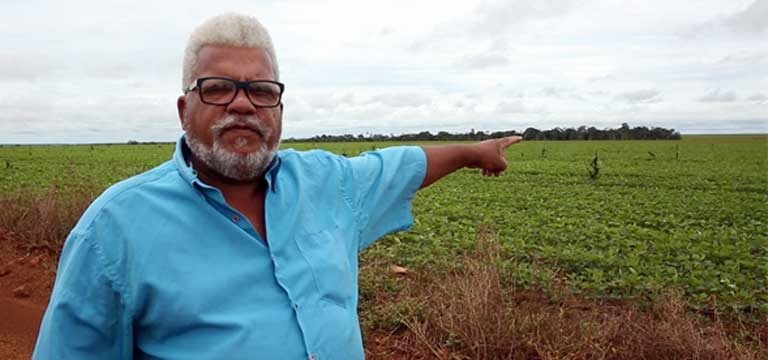
Jair Marcelo da Silva, known as Capixaba, a farmer from the Wesley Manoel dos Santos settlement. This vast soy plantation was once the settlement’s forest reserve, which was illegally clear cut and then taken over by large-scale soy farmers.
Agribusinesses in Brazil have illegally cleared protected
forests in agrarian reform settlements to cultivate soy. A recent investigation
by Mongabay found
that the Wesley Manoel dos Santos settlement, located in the state of Mato
Grosso and known as Gleba Mercedes, has lost 3,500 hectares (ha) of its natural
forest to soy plantations.
By law, settlers are required to keep a portion of their
individual plots as forests. However, according to local settlers interviewed
by Mongabay in November 2016, the Gleba Mercedes’ collective reserve has been
illegally cleared by soy farmers using the correntão – a
100-metre long chain pulled by tractors that knocks down all forest in its
path.
Settlers believe that a corrupt employee at the National
Institute for Agrarian Reform, the federal authority responsible for granting
the settlements to landless peasant families, illegally ceded the forest to soy
farmers.
Mongabay highlights that this is not a unique case of the
“criminal advance of agribusiness into agrarian reform settlements”. In 2004,
the Federal Police arrested more than 20 people connected to illegal soy
cultivation at the Tapuráh-Itanhangá settlement, also in Mato Grosso.
Driven by the global commodities boom and increasing Chinese demand, the state of Mato Grosso has seen an enormous expansion of areas under soy cultivation over recent decades, jumping from 1.2 million ha in 1991 to 9.4 million ha in 2016.
This has led to the further concentration of land ownership in
the state, and environmental and social pressures. Soy agribusinesses have
acquired significant political clout at the state and federal levels.
A case in point, highlighted by Mongabay, is the presidential decree issued by Brazilian President Michel Temer in December 2016.
The decree makes it easier for agribusinesses to buy plots of land from settlers and allegedly intends “to legalize the illegal occupation of agrarian reform land”.
Settlers, with few economic alternatives and almost no support
from the federal government, find themselves under pressure to sell their land
where soy cultivation continues to expand.