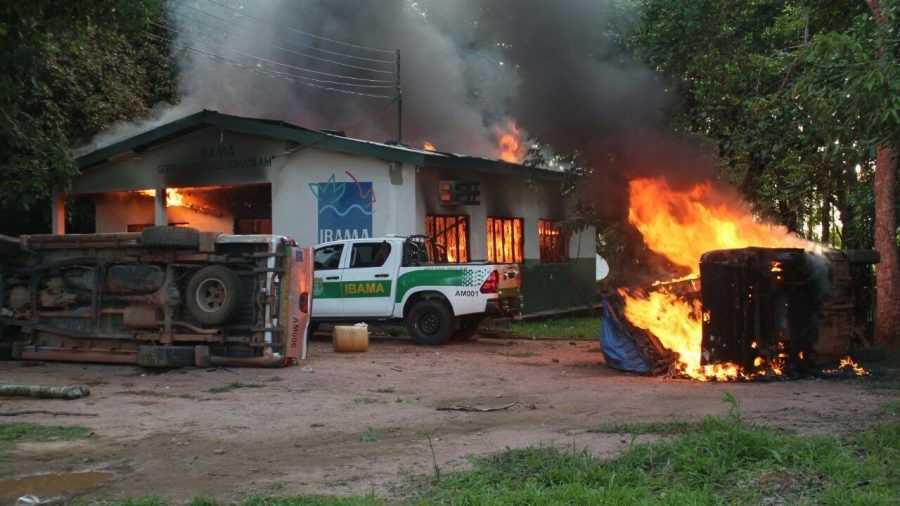
Flames consume Ibama's Humaita HQ
Collusion between local authorities and criminal gangs is
exacerbating illegal deforestation in the Amazon, Brazil’s head of environmental
law enforcement has told delegates at the COP 23 climate conference.
“There is evidence of coordinated activity involving local
politicians and organized crime,” said
Luicano Evaristo, director of Brazil’s environmental enforcement agency
Ibama. “When Amazon state governors arrive here and promise, ‘we will commit to
zero deforestation’, ask them how many permits they are granting. There is
not enough forest for the number of permits.”
His comments come two weeks after the latest
series of assaults on agencies tasked with protecting the Brazilian
Amazon.
On 27 October, a mob torched Ibama’s office and four pickup
trucks in Humaitá, a city in Amazonas state. That night, an office and boat
belonging to ICMBio, a conservation agency linked to Brazil’s Environment
Ministry, were also set ablaze. Police escorted officials from both bodies to
safer locations outside the city.
“We have lost 14 pickups in criminal attacks against Ibama
this year alone,” Evaristo said.
See EARTHSIGHT’s previous coverage of violence against
enforcement officials in the Brazilian Amazon here
One of the founders of Greenpeace Brazil, Paulo Adario,
added that the Amazon is experiencing a “wild west moment”.
“Crime has become the rule in Brazil because the example
comes from above,” Adario said at the conference in Bonn.
The administration of Brazilian President Michel Temer has
been accused of tacitly endorsing illegal deforestation and land grabbing
through its legislative programme.
A bill to downgrade the protections governing 350,000
hectares of Jamanxim National Forest is currently making its way through the
Brazilian parliament. Similar boundary changes have been used to greenwash illegal deforestationfor beef.
In July, a law altered a land registration programme by bringing forward the cut-off date after which land
could not be registered, seen as helping legitimise land grabs. The bill also
removed a regulation which stripped claimants of their title to land if they
cleared it of forest.
Campaigners warn that an effect of such measures is to
create a sense of impunity, incentivising future illegality.
“The state, which has responsibility not only for upholding
the law but also for protecting 70 million hectares [of Amazon rainforest], is
sending the message that crime can be rehabilitated, and that illegal activity
is tolerated,” Marcio Astrini of Greenpeace Brazil said at the talk in Bonn.