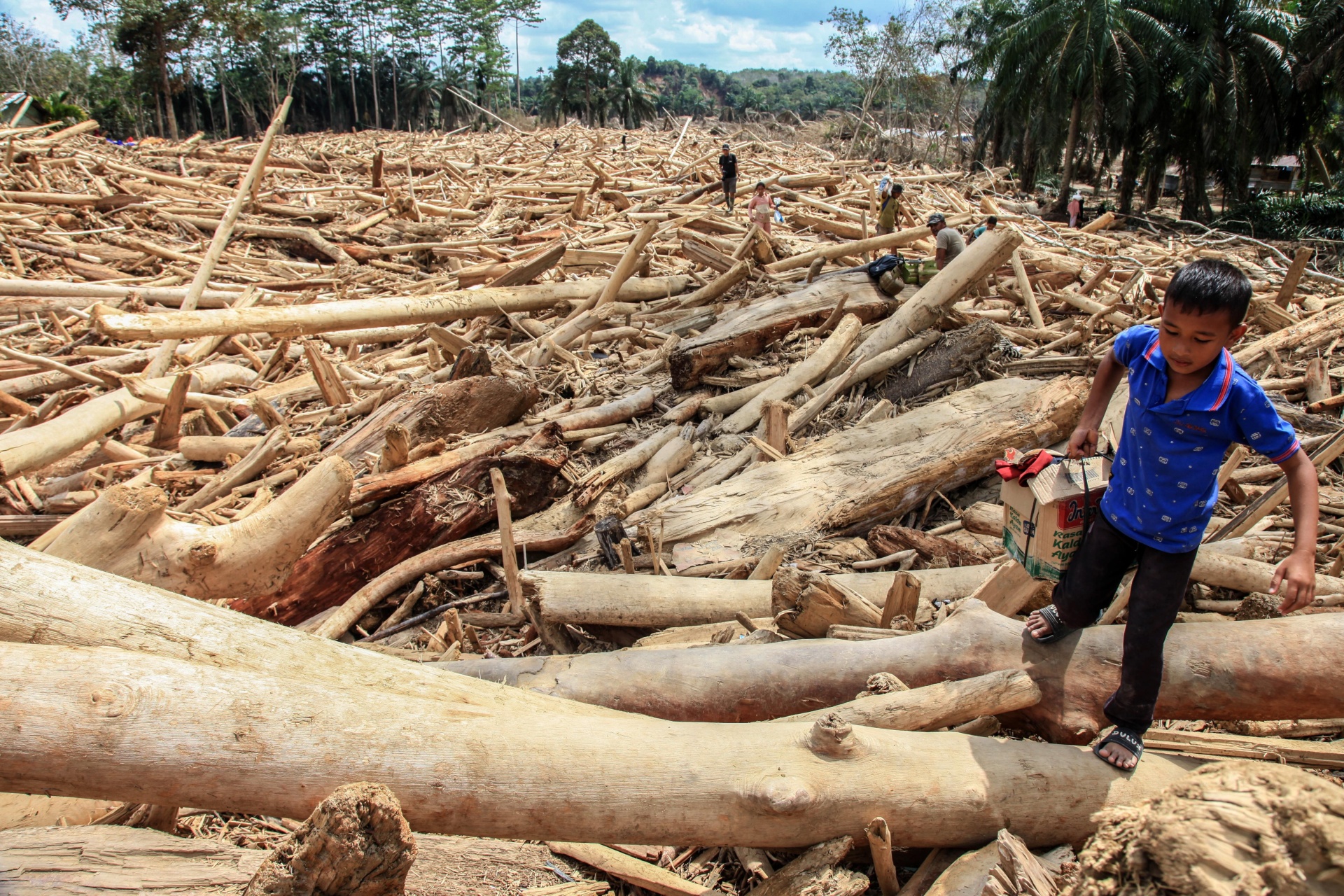
Timber carried downstream by floods in Sumatra in November 2025
- A new investigation by Earthsight and Auriga exposes a major timber and pulp company for having contributed to deadly floods in Sumatra, Indonesia, through massive illegal deforestation in its concession
- The Indonesian government and civil society have blamed rampant deforestation in Sumatra for exacerbating floods and landslides that have killed more than 1100 people since 26 November 2025
- One of the worst affected areas, Batang Toru, saw destructive rivers of logs and logging debris swept down river valleys, videos of which garnered millions of views on social media and led to public outcry
- We found that large tracts of virgin forest and orangutan habitat have been cleared illegally within the concession of timber plantation and pulp company PT Toba Pulp Lestari (PT TPL). The cleared forest was on steep slopes upstream of hard-hit areas, in an area zoned as protected, and officially recognised as facing high risk of landslides. Satellite imagery shows landslides right next to recently cleared areas
- The company has claimed the illegal deforestation was carried out by a third party, but field surveys indicate some deforested areas have since been planted with monoculture eucalyptus plantations
- We traced the wood pulp the company produces to a major manufacturer and exporter of ‘rayon’ made from wood fibres, used in the manufacture of clothing and other products sold across the globe
- Responding to the findings, PT TPL asserted that all its operations are legal; that it does not cut any natural forests; and that there is no connection between the company’s activities and the floods and landslides
The world has watched with horror and sadness as floods and landslides have destroyed thousands of homes and cost more than 1100 lives in Sumatra, Indonesia, since Cyclone Senyar made landfall on 26 November.1
Indonesian activists have pointed to mining and forestry companies as having exacerbated the disaster by clearing large areas of forest in Sumatra. New research by Earthsight and Auriga Nusantara has identified hundreds of hectares of illegal deforestation in land controlled by one of these companies, upstream of one of the hardest-hit areas.
The company – PT Toba Pulp Lestari – is a major supplier of wood pulp to a factory producing cellulose fibres for fabric which is ultimately sold to consumers in the US and Europe. The case highlights the dreadful consequences of environmental destruction driven by under-regulated trade in wood products – and the role of international consumption.
A deadly torrent of timber
Heavy rainfall brought by Cyclone Senyar in late November 2025 triggered flash flooding and landslides across much of Sumatra, the worst-hit region in a disaster that has affected large parts of Southeast Asia. More than a million people have been evacuated from their homes, while the collapse of roads and bridges have left many others stranded, complicating aid and rescue efforts.
One of the hardest-hit regions is Tapanuli, North Sumatra, in the watershed of the Batang Toru river. At least 251 people are reported to have lost their lives in the region, as of 2 January 2026.2 Shocking footage of floodwaters in Tapanuli carrying huge quantities of logs and timber debris – the exact origin of which remains uncertain – has been widely shared online.
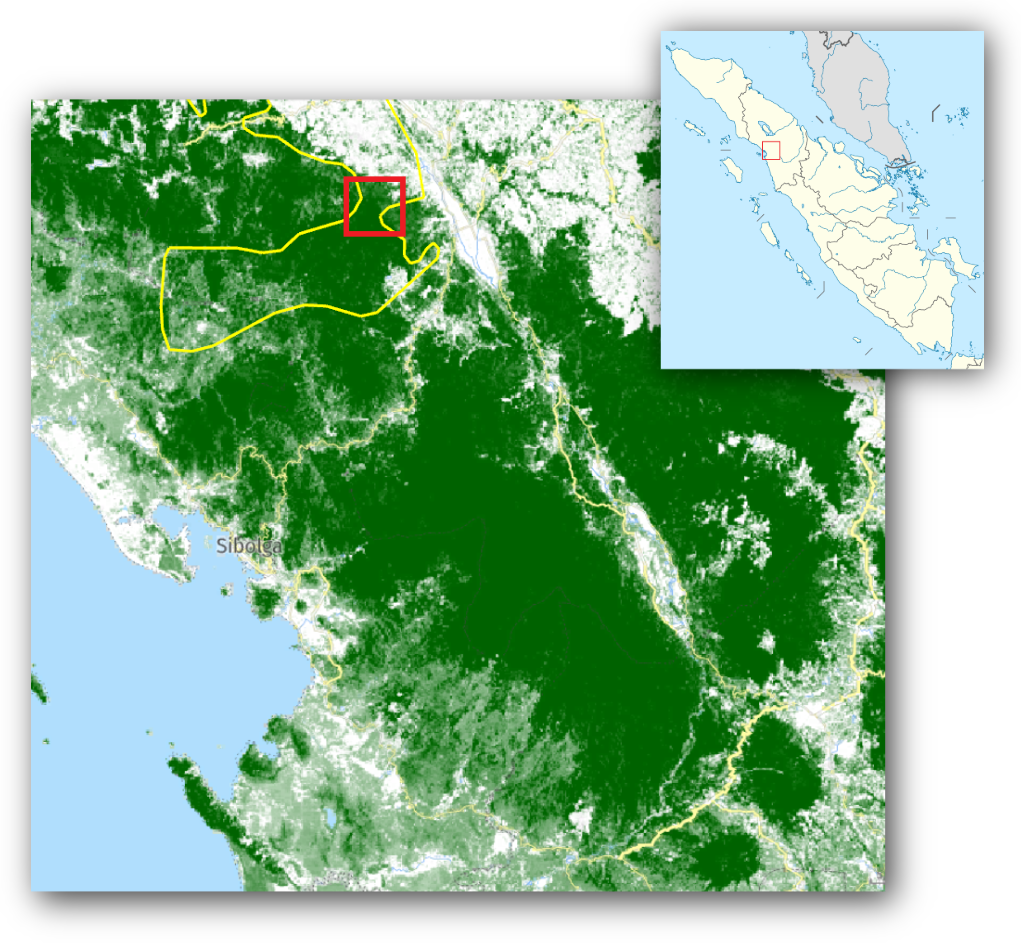
Map of Batang Toru river basin in Sumatra, with PT Toba Pulp Lestari’s Aek Raja timber concession in yellow and the location of recent illegal deforestation in red. Dark green indicates remaining natural forest cover with 7m+ canopy height as of 2020
The Indonesian government has pointed to extensive deforestation in Sumatra as a key factor in the recent disaster, with environment minister Hanif Faisol Nurofiq stating it “cannot be attributed solely to natural causes.” President Prabowo Subianto was quoted as saying in reference to the disaster: “We must truly prevent deforestation and forest destruction.” He declared during a visit to affected areas of North Sumatra that the government is cracking down on illegal logging.
On 1 December, Nurofiq announced that his office has evidence of eight companies whose activities potentially contributed to the landslides and floods seen in the Tapanuli area. Subsequently on 15 December, forestry minister Raja Juli Antoni announced that the President had ordered an audit and evaluation of the timber plantation company PT Toba Pulp Lestari (PT TPL), which controls several large blocks of land in North Sumatra.
PT TPL was also among seven companies named by Indonesian environmental NGO Walhi as having contributed to the flooding and landslides in the Tapanuli region through clearance of forests and damage to ecosystems.
Fresh research by Earthsight and Auriga supports this: we found large tracts of protected virgin forest and orangutan habitat have been cleared illegally on steep slopes within a part of the PT TPL concession upstream of the disaster, and identified evidence of landslides associated with the deforestation.
Massive illegal deforestation
Our analysis of satellite imagery from upland forest areas in the Batang Toru watershed and neighbouring river basins in the year leading up to the disaster identified three significant blocks of recent deforestation or logging. One of these is within an estate which is part of PT Toba Pulp Lestari’s concession, where the company has a license to develop monoculture plantations of eucalyptus to supply its huge pulp mill.
We found that between March 2021 and 1 December 2025, a total of 758 hectares (ha) of pristine natural upland forest were cleared in the Aek Raja block of PT TPL’s concession. The industrial-scale logging and bulldozing has also extended to a further 125ha beyond the concession boundaries.
Progression of deforestation within the PT Toba Pulp Lestari Aek Raja Estate, 2021–2025. The TPL concession boundary is shown in green; forest clearance can be clearly seen extending beyond the company’s concession © Earthsight. Image source: Sentinel-2 via Copernicus Browser
Altogether, an area more than 2.5 times the size of New York’s Central Park has been cleared. After continuing at a steady pace for several years, the clearing accelerated in the weeks leading up to the disaster, with more than a football pitch-sized tract of precious forest being bulldozed daily.
This deforestation continued through November 2025, right up until the cyclone hit. Satellite images from 1 December, in its immediate aftermath, show that landslides occurred next to the most recent logging activity (see images below).
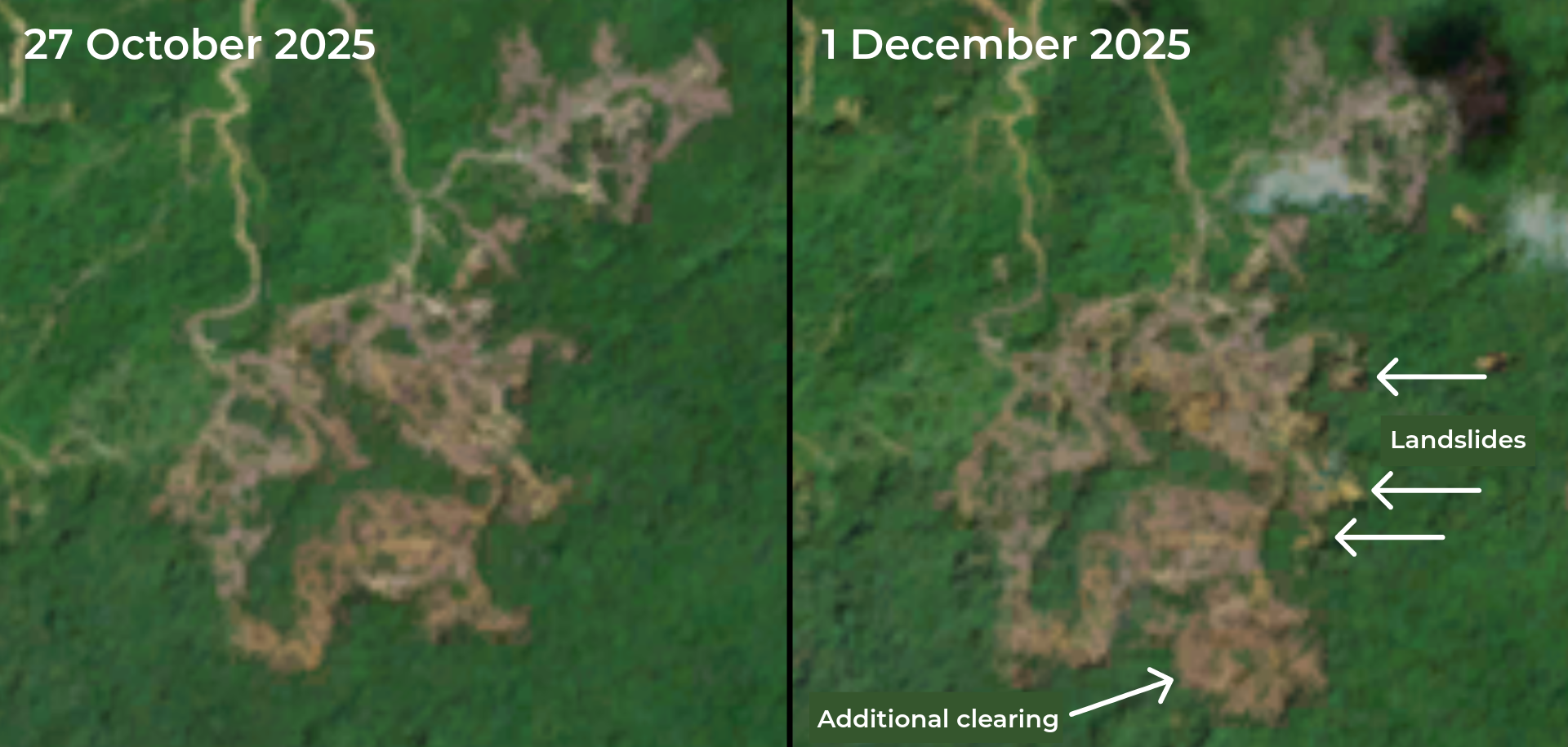
Satellite images from before and after Cyclone Senyar show landslides next to recently deforested areas extending from within the PT Toba Pulp Lestari concession © Earthsight. Image source: Sentinel-2 via Copernicus Browser
Indonesian government maps indicate that this area, which comprises steep terrain, is at particular risk of landslides. For that reason, this part of the PT TPL concession is zoned as ‘limited production forest’, where forest clearance is not normally allowed.3 PT TPL has admitted that Indonesian authorities declared 11,315ha of the Aek Raja estate – a quarter of its area – as ‘protected forest’, and available maps indicate the recently deforested area lies within that zone. The activity seen therefore isn’t just destructive: it appears to be entirely illegal.
PT TPL’s own assessment of forests in its concession, published in 2024, concluded that this part of their license area contains nationally significant concentrations of threatened species, and is also crucial for the control of erosion on vulnerable steep slopes. Maps of orangutan habitat from 2019 identified parts of the recently cleared forest as being potentially occupied by Tapanuli orangutans, a unique species found only in the Batang Toru ecosystem which is the most threatened of all great apes.Responding to our findings, PT TPL told Earthsight and Auriga that its own research had “not identified any forest clearance of 883 hectares within the area referenced”. It instead referred to an area of community managed land nearby, which it said is “managed under a Forest Partnership scheme, implemented in accordance with applicable regulations”. The map provided by the company of this scheme is to the north of the illegally logged area we detected, and does not overlap with it.
PT TPL further stated that “based on spatial, hydrographical, topographical and operational data”, no landslides or floods could be attributed to the company’s activities. However, the evidence the company provided relates only to the company’s estate in South Tapanuli, and to flood sites in the Nabirong River watershed and at Sipirok on a tributary of the Batang Toru River. Earthsight and Auriga do not allege that the activities seen in PT TPL’s Aek Raja estate in North Tapanuli contributed to the impacts of flooding at these specific locations, which are not downstream of the Aek Raja estate, but that those activities instead contributed to landslides and floods elsewhere in the affected region.
PT TPL also asserted that it does not log natural forests, complies with all relevant regulations, and protects high conservation value forests (read the full response from PT Toba Pulp Lestari here).
On 6 December 2025, the Directorate General of Enforcement at the Indonesian Ministry of Forestry revealed that it had sealed five locations in the Tapanuli area identified as potentially having contributed to the damage wreaked by the recent events, including two locations within the PT Toba Pulp Lestari concession.
The sealing of these areas, officials stated, was to “secure the location, prevent further activities that could worsen the situation, and to obtain strong legal evidence for further law enforcement processes.” The agency said that it was coordinating with the National Police to jointly pursue criminal action against companies suspected of contributing to the disaster, including through the use of money laundering laws to seize assets.
Regarding the actions by the Indonesian government to halt the company’s activities and launch an audit, PT TPL told Earthsight and Auriga that it has “conducted all activities in compliance with Indonesian regulations” and that the actions taken by the government are part of an “information gathering and evidence-collection process” which “does not constitute the imposition of sanctions or a determination of proven violations.”
Repeated allegations of deforestation and rights abuses
Deforestation in this area has been exposed before: in July 2024, the NGO Rainforest Action Network (RAN) reported on forest clearance in this part of the PT Toba Pulp Lestari concession. In 2024, PT TPL told RAN that the activity was illegal encroachment and illegal logging by third parties, and that they had reported this to the relevant authorities in 2023.
However, the pattern of activity visible through satellite imagery looks like that typically seen in development of industrial timber plantations, and does not resemble smallholder-associated agricultural encroachment or selective illegal logging. The images show a large, industrial-scale operation, requiring the cutting of more than 30km (18 miles) of logging roads through difficult steep terrain, and the construction of numerous log bridges to cross the many small streams and rivers. It would have taken at least 2000 large trucks to remove the logs.
Findings of a field survey of the affected area conducted by Earthsight and Auriga in December 2025 confirm the scale of the activity, and prove it has led to landslides (see picture below). We recorded logging on extremely steep slopes, which is prohibited under Indonesian law.
The survey also documented heavy machinery and piles of tropical logs stacked beside the road which leads to the most recently deforested area. The logs lacked markings that are mandatory under Indonesia’s timber legality and traceability system – indicating they were illegally sourced.
High-resolution satellite imagery from September 2025 also shows that some illegally logged areas of forest have since been replaced with monoculture tree plantations – which would be very odd for illegal loggers to do.
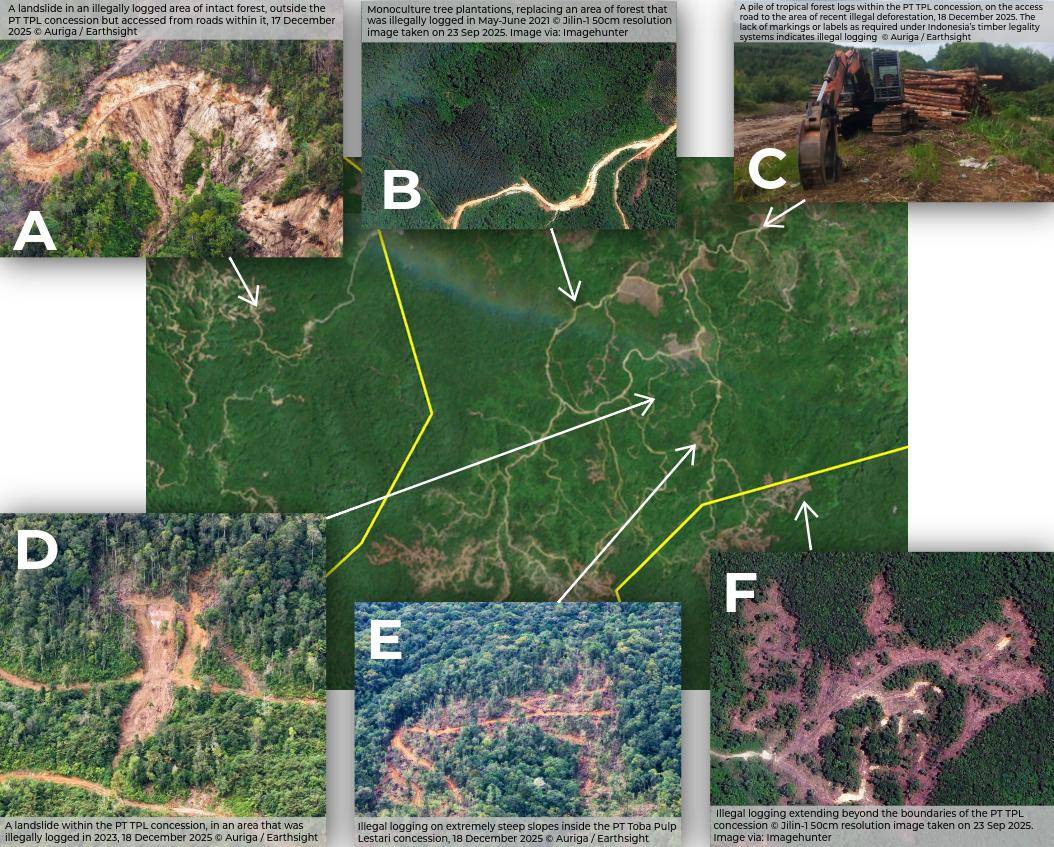
Findings from Earthsight/Auriga analysis. Underlying satellite image is from 27 October 2025, prior to the floods © Earthsight. Image source: Sentinel-2 via Copernicus Browser
Even if this forest clearance was illegal activity by third parties, it is the legal responsibility of PT TPL to prevent such activity within its concession. A 2024 report by the company states that it is committed to “protecting forest areas from illegal activities in all operations.” At a minimum, the company has abjectly failed to abide by this.
Indications from elsewhere suggest that the company is not just neglecting to address illegal activity, but may be allowing illegal logging to happen, then benefiting when the authorities give the green light to 'reforest' the area concerned with monocultures. This way the company gets to expand its plantations while still claiming it has not converted any natural forest.
Evidence to support this can be found in PT TPL’s 2024 annual management plan, and in an audit report for the same year produced under Indonesia’s timber legality assurance system, SVLK. Both documents refer to “restoration” or “enrichment” activities (namely, planting of monocultures) by PT TPL in protected forest areas within the firm’s concession. Neither document explains why these protected forests would require such ‘restoration’, but illegal logging by a mysterious third party seems a good bet.
Responding to our findings, PT TPL admitted to planting in areas disturbed by “unauthorized third-party activities” but said this was an obligation under its permit. The company stated that “any interpretation that equates … rehabilitation or enrichment measures [in such areas] with an acknowledgment of illegal logging by the Company is inaccurate.”
Where were the authorities in all of this? If it is true that PT TPL alerted them to illegal deforestation as along ago as 2023, then why wasn’t the operation stopped? Why did the authorities not act? Why did PT TPL not continue to press them to do so?
We asked PT TPL which authorities were contacted in 2023 and what follow-up attempts had been made to ensure action was taken. The company responded that the illegal activity was “reported to the relevant authorities in 2023 with the copies to Forest Management Unit Region XII Taratung, Village Head and Sub-District Head on 10th November 2023.” The company made no mention of any follow-up communication, and declined to share the 2023 report to the authorities because it is “part of ongoing … law enforcement processes.” 4
Even if PT TPL did not report the illegal logging as they claim, it is at best a dereliction of duty on the part of the authorities to have not themselves noticed an operation on this scale, happening in plain sight.
“The Anti-Corruption Commission must investigate why the authorities have turned a blind eye to this,” says Timer Manurung, Chair of Auriga Nusantara. “It's hard to believe that an incident of this magnitude could have occurred over four years without the knowledge or involvement of PT Toba Pulp Lestari and local authorities,” he says.
Meanwhile, PT Toba Pulp Lestari has repeatedly been accused of human rights violations in its conflicts with local communities. In the most recent incident in September 2025, PT TPL security forces injured more than 30 members of the Indigenous Ompu Mamontang Laut Ambarita community who were farming customary land near Lake Toba. The incident was condemned by Indonesia’s National Human Rights Commission, suggesting it violated rights including those to security, freedom from torture and a healthy environment. Given the opportunity to comment on this when presented with the findings in this report, the company referred to a published statement from September 2025. 5
Supply chain links
What has happened to the wood produced through destruction of natural forest in the PT TPL concession? Earthsight analysed documents submitted to Indonesian authorities by PT Toba Pulp Lestari’s mill, known as RPBBI (Rencana Pemenuhan Bahan Baku Industri, or ‘Industrial Raw Materials Fulfilment Plan’), which detail from where and in what quantities a wood product company sourced their supplies of logs or semi-processed wood. No consumption of natural forest timber (as opposed to wood from plantations) was declared in the mill’s reports from 2021 to 2024.
Yet Earthsight estimates that as much as 80,000 cubic metres of tropical logs will have been produced through the clearance of primary forest in the PT TPL concession in North Tapanuli district during that period. No other mill has reported receiving this timber, and it must have gone somewhere – suggesting the logs may have entered the company’s supply chains undeclared.
Where the wood pulp from PT TPL’s mill is going is certainly much clearer. Sixty-four per cent of the raw materials that the mill uses come from its own monoculture timber plantation in North Sumatra. The company’s latest 2024 annual report states that 84 per cent of its sales were to PT Asia Pacific Rayon (APR),6 part of the Royal Golden Eagle (RGE) group, one of Indonesia’s largest plantation and forestry firms. RGE has been the subject of repeated allegations of illegal deforestation and human rights abuses over the last 15 years.7
APR has a 325,000-tonne capacity mill in Riau, Sumatra, which produces viscose rayon fibre, used to manufacture fabric and made out of cellulose, usually wood pulp fibres. APR’s 2024 annual report confirms that 43 per cent of its raw materials came from Toba Pulp Lestari.8
Rayon production for clothing is a major consumer of wood, using 200 million trees every year according to the NGO Canopy, which has also warned that almost half of global production comes from ancient or endangered forests. APR – one of the world’s largest producers – ranked 27th out of 30 viscose fibre producers for sustainability in Canopy’s 2025 Hot Button Report.
Indonesian customs records obtained and analysed by Earthsight show that APR exported $232 million of viscose rayon between January and October 2025, with the majority sold to Turkey, Bangladesh, Pakistan and India. APR’s customers in these countries produce rayon clothing and other goods for export to the US, EU and UK – onward connections that APR advertises on its own website.
We have identified supply chain connections to household name retailers in the United States and Europe. We will be publishing details of these links in early 2026.
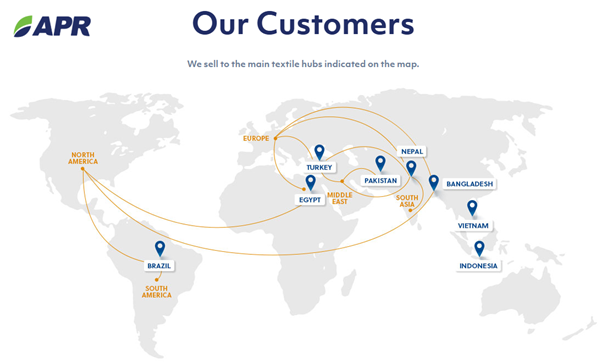
Supply chain map from Asia Pacific Rayon’s website, December 2025
False promises
The deforestation in PT TPL’s concession flies in the face of sustainability policies flaunted by multiple companies in the supply chain. PT Toba Pulp Lestari’s current sustainability policy states that the company and its suppliers “stopped logging natural forests” in June 2014. RGE adopted a ‘zero-deforestation’ policy across its companies in 2015, in response to international outcry over its operations. Meanwhile RGE subsidiary APR’s 2024 sustainability policy claims that the company does not obtain raw materials from “areas where there is conversion of natural forest to plantations.”
In addition, RGE and PT TPL have both promised to identify and protect all High Conservation Value (HCV) and High Carbon Stock (HCS) forest inside their concessions.
To give its buyers further assurance, in 2019 APR launched a public system called ‘Follow Our Fibre’, which allowed users to track fibres back to the location of harvest. In 2024, the system was taken offline.9 The reason given was to “refine” the system to meet requirements under the upcoming EU Deforestation Regulation (EUDR), which will oblige importing companies in the EU to trace the origin of certain products back to the point of harvest and check no deforestation has happened there since 2020.10
One can’t help wondering if the real reason the system was taken down was that APR didn’t want its buyers to start doing such checks – and uncovering its dirty laundry.
Faced with a tragic reminder of the consequences of unfettered deforestation, Indonesian government authorities must act urgently to investigate illegal forest clearance in the PT Toba Pulp Lestari concession, prosecuting those responsible and demanding restoration of the forest affected.
At the same time, the government should issue new regulations to ban clearance of remaining natural forest in the country, including within concessions and on private land, in recognition of the essential role it plays in disaster resilience, as well as biodiversity preservation and the lives of local and Indigenous communities.
International buyers of rayon products must investigate their supply chains to ensure they are not buying products linked to PT Toba Pulp Lestari or other deforesting companies in Indonesia.
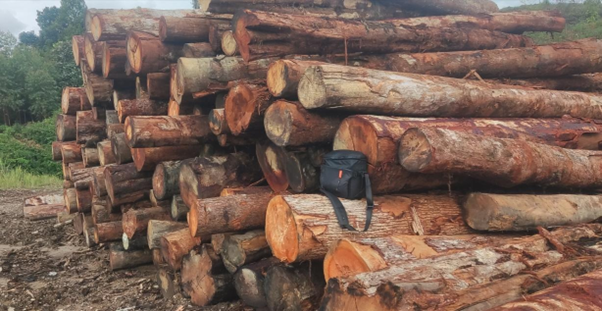
Tropical forest logs pictured within the PT TPL concession, 18 December 2025. The lack of markings or labels as required under Indonesia’s timber legality systems indicates illegal logging
Recommendations
The Indonesian government must:
- urgently investigate illegal logging in the Aek Raja block of the PT Toba Pulp Lestari concession, and in nearby forests accessed from within it, establishing who was responsible and where the timber went. They must punish those responsible for carrying out the logging and receiving the stolen wood to the maximum extent of the law. They should also investigate whether there is evidence of incompetence or corruption on the part of local law enforcement
- issue a regulation that provides legal protection for all remaining natural forest in the country, including in concessions and on private land, which would mean any deforestation in Indonesia would be categorised as illegal
PT Toba Pulp Lestari must:
- immediately cease clearance of natural forest in its concession
- restore recently deforested areas
- publish official management plans for its forestry concession
- implement effective conservation of protected forest areas
PT Asia Pacific Rayon must:
- immediately halt all purchase of wood fibre from PT Toba Pulp Lestari, pending further investigation into deforestation in the company’s concession
- increase transparency of its supply chain, including putting the ‘Follow Our Fibre’ platform back on line
- abide by its own sustainability policy by ceasing purchase of any wood pulp from concessions where there has been recent deforestation
European, US and UK firms selling rayon products must:
- urgently interrogate their supply chains and ensure that their raw materials are not coming from PT Toba Pulp Lestari
- shift their purchasing to rayon producers with much better track records, as identified by Global Canopy
Notes
1 Indonesia’s National Board for Disaster Management (BNPB) lists 1157 deaths as of 2 January 2026: https://gis.bnpb.go.id/BANSORSUMATERA2025/
2 Total of deaths reported by Indonesia’s National Board for Disaster Management (BNPB) from South Tapanuli (88), North Tapanuli (36) and Central Kalimantan (127) regencies, as of 22 December 2025
3 Areas zoned as ‘limited production forest’ also viewable via: https://geoportal.menlhk.go.id/portal/apps/webappviewer/index.html
4 Letter from PT Toba Pulp Lestari to Earthsight and Auriga, 23 December 2025
5 Toba Pulp Lestari, TPL Statement on Conflict at its Forestry Concession Aek Nauli Sector, Simalungun Regency, 29 September 2025, https://www.tobapulp.com/media/statements/ 6 See page 246, PT Toba Pulp Lestari 2024 annual report, https://www.tobapulp.com/wp-cont
6 See page 246, PT Toba Pulp Lestari 2024 annual report, https://www.tobapulp.com/wp-content/uploads/2025/04/AR2024.pdf
7 For example: Greenpeace International, ‘Under the Eagle’s Shadow: Investigating the RGE/Tanoto Shadow Empire’, May 2025, https://www.greenpeace.org/international/publication/74651/under-the-eagles-shadow/; The Gecko Project, Bloomberg News, ‘Insider testimony points to “sustainable” conglomerate as hidden hand behind destruction of rainforest’, 15 October 2024, https://thegeckoproject.org/id/articles/insider-testimony-points-tosustainable-conglomerate-as-hidden-hand-behind-destruction-ofrainforest/
8 See page 68, APR Sustainability Report 2024, https://www.aprayon.com/wp-content/uploads/2025/08/Asia-Pacific-Rayon-APR-Sustainability-Report-2024.pdf
9 The company states that sourcing data is still available to customers on request
10 Rayon is in fact not covered under the EUDR, and EU importers are therefore not required to conduct due diligence or obtain information on the point of harvest of the wood pulp it was made from