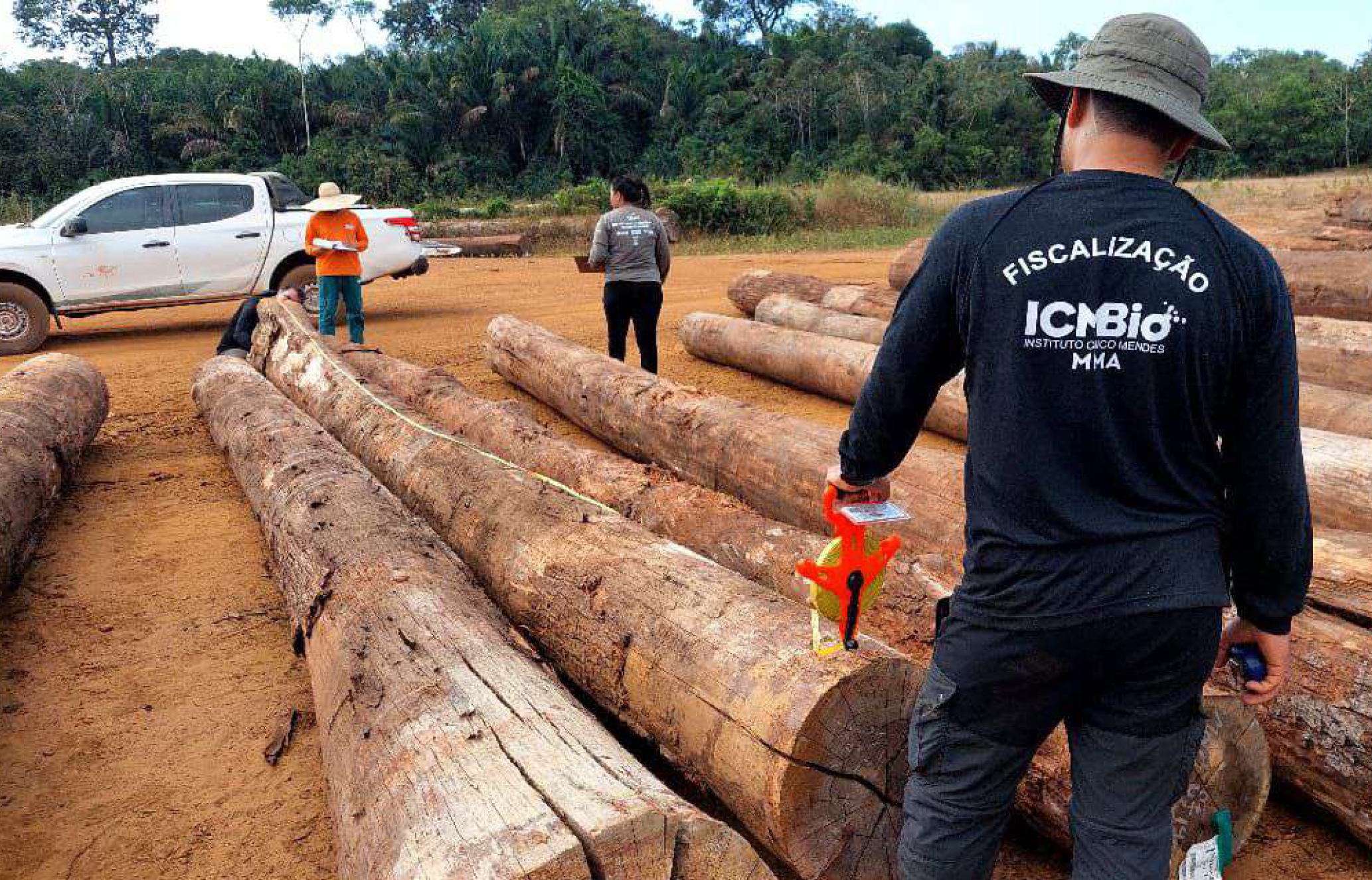
ICMBio agents measuring the volumes of 602 logs as part of their investigation at Samise's log barging station, located in the municipality of Terra Santa, Pará. July 2023. Included in Ordinary civil proceeding 1023402-56.2023.4.01.3902, 2023
On World Rainforest Day, a new investigation by Earthsight reveals two Dutch companies providing timber for the construction of decking and infrastructure in the Netherlands have sourced thousands of cubic metres of suspect wood from the Brazilian Amazon.
London, 22 June 2026. Two of Europe’s biggest buyers of high-risk timber from Brazil – Hoogendoorn Hout and Van den Berg Houtgroep – have purchased timber from a company that has faced multiple suspensions, €1.2 million worth of fines and even a criminal conviction.
The company in question is Samise Indústria Comércio e Exportação Ltda. Investigative NGO Earthsight, with support from the Center for Climate Crime Analysis (CCCA), analysed satellite images, court rulings, timber movement documents and shipment records to uncover myriad allegations of illegality across 2023 in Samise’s concession in Saracá-Taquera National Forest, Pará.
Samise was suspected of tampering with identification markings on over 600 logs worth an estimated €100,000 – a practice used by companies to conceal timber’s true origins, indicating potential illegality.
On another occasion, a routine inspection of Samise’s concession uncovered evidence of fraud, prompting a suspension of its operations. The company blatantly violated the suspension by illegally transporting 3800m3 of angelim vermelho to a sawmill called Greenex.
Greenex proceeded to export around 3000m3 of angelim vermelho originating from Samise to the Netherlands between July and December 2023. Almost 90 per cent was bought by Hoogendoorn Hout and Van den Berg Houtgroep. Most recent available data from 2025 indicates these supply chain links continue.
Angelim vermelho is a hardwood known for its strength and durability. Once Samise’s timber reaches the Netherlands, it is sold to clients for the construction of decking and other projects. Angelim vermelho processed by these companies can be found across the country, from the veranda of a boutique hotel in Veluwe National Park to a marsh woodland boardwalk in Zoetermeer.
Samise’s concession was first certified by the Forest Stewardship Council (FSC), the world’s leading timber green label, in 2016. Despite numerous allegations of illegal activity and multiple suspensions of Samise’s FSC certificate between 2023 and 2025, the company did not have its certification terminated until March 2026. The decision was taken on the day that Earthsight shared its findings with FSC and the certification body responsible for assessing Samise’s compliance – which Earthsight was told was coincidental.
Hoogendoorn Hout and Van den Berg Houtgroep claimed to undercover Earthsight investigators to only stock FSC-certified angelim vermelho, despite several periods during which Samise’s FSC certificate was suspended and timber from its concession continued to flow to the two companies.
The EU Timber Regulation (EUTR) is intended to keep illegal wood off the EU market, yet Samise’s is the latest in a string of cases of illegal timber slipping through the net. A major flaw in the implementation of the EUTR has been companies’ overreliance on certification as evidence of legality. Meanwhile EU-wide reviews reveal enforcement has been patchy and serious penalties rare.
Rafael Pieroni, Earthsight’s Latin America Team Lead, said:
"The fact that Samise’s timber has freely entered the Netherlands exposes weak points in the EUTR. Companies’ efforts to comply with the EU Deforestation Regulation (EUDR), set to replace the EUTR from December 2026, must go beyond surface-level checks on their supply chains. European importers must refrain from treating certification as a substitute for rigorous due diligence.”
Samise’s 59,408-hectare concession is an area almost the size of Barcelona, and its operations are some of the largest in Brazil. In 2021, the company produced more logs than any other federal concession had ever done before. In 2025, it planned to break that record.
Saracá-Taquera, where Samise’s concession is located, stretches over 429,000 hectares of dense Amazon rainforest and provides habitat for critical species, including the jaguar and giant otter. As part of a strategy to combat illegal logging, the Brazilian government intends to triple timber concession areas in federal forests, despite scientific research indicating that current logging limits are unsustainable and incompatible with the Amazon’s regeneration dynamics. Combined with the risk of illegal activity in federal concessions as laid bare in Samise’s case, these findings beg the question as to whether the government’s plans will help or harm the rainforest.
ENDS
Notes to Editors
- Earthsight is a London-based non-profit committed to exposing environmental and social crimes and their links to global consumption.
- Earthsight holds copies of documents evidencing allegations, fines and convictions against Samise where these are not publicly available.
- Greenex has been Brazil’s leading exporter of angelim vermelho for years running, responsible for a quarter of all exports from 2023 to 2025. The Netherlands is Greenex’s number-one export destination, accounting for over 95 per cent of its exports from July to December 2023.
- Van den Berg Houtgroep was formed in January 2026 when three Dutch timber importers merged into one company. These companies were GWW Houtimport and its subsidiary GWW Agency, and Van den Berg Hardhout. Imports of Samise’s timber by these three companies are referred to as imports by Van den Berg Houtgroep for the sake of clarity.
- Earthsight analysed EU imports of high-risk Brazilian timber between January and September 2023 and found Hoogendoorn Hout and the companies now comprising Van den Berg Houtgroep were the largest buyers. Timber is deemed ‘high-risk’ if its species grows only in natural forests as opposed to plantation-grown wood, which makes up most of Brazil’s timber exports.
- The EU Timber Regulation (EUTR) bans the placing of illegal timber on the EU market. It requires importing companies to trace their supply chain and carry out due diligence to assess and mitigate risks of illegality. The EUTR has been enforced since 2013.
- The EU Deforestation Regulation (EUDR), set to replace the EUTR, requires that products placed on the EU market do not originate from land deforested after 31 December 2020, and were produced in compliance with producer-country laws. The EUDR covers wood, coffee, cocoa, palm oil, soy, rubber and cattle products. The law was originally to be enforced from 30 December 2024, but has been delayed twice in response to industry lobbying. The EUDR is now to be enforced from 30 December 2026.
Contacts
Earthsight Latin America Team lead, Rafael Pieroni (rafaelpieroni@earthsight.org.uk)
Earthsight Senior Researcher / Campaigner: Latin America, Lara Shirra White (larashirrawhite@earthsight.org.uk)