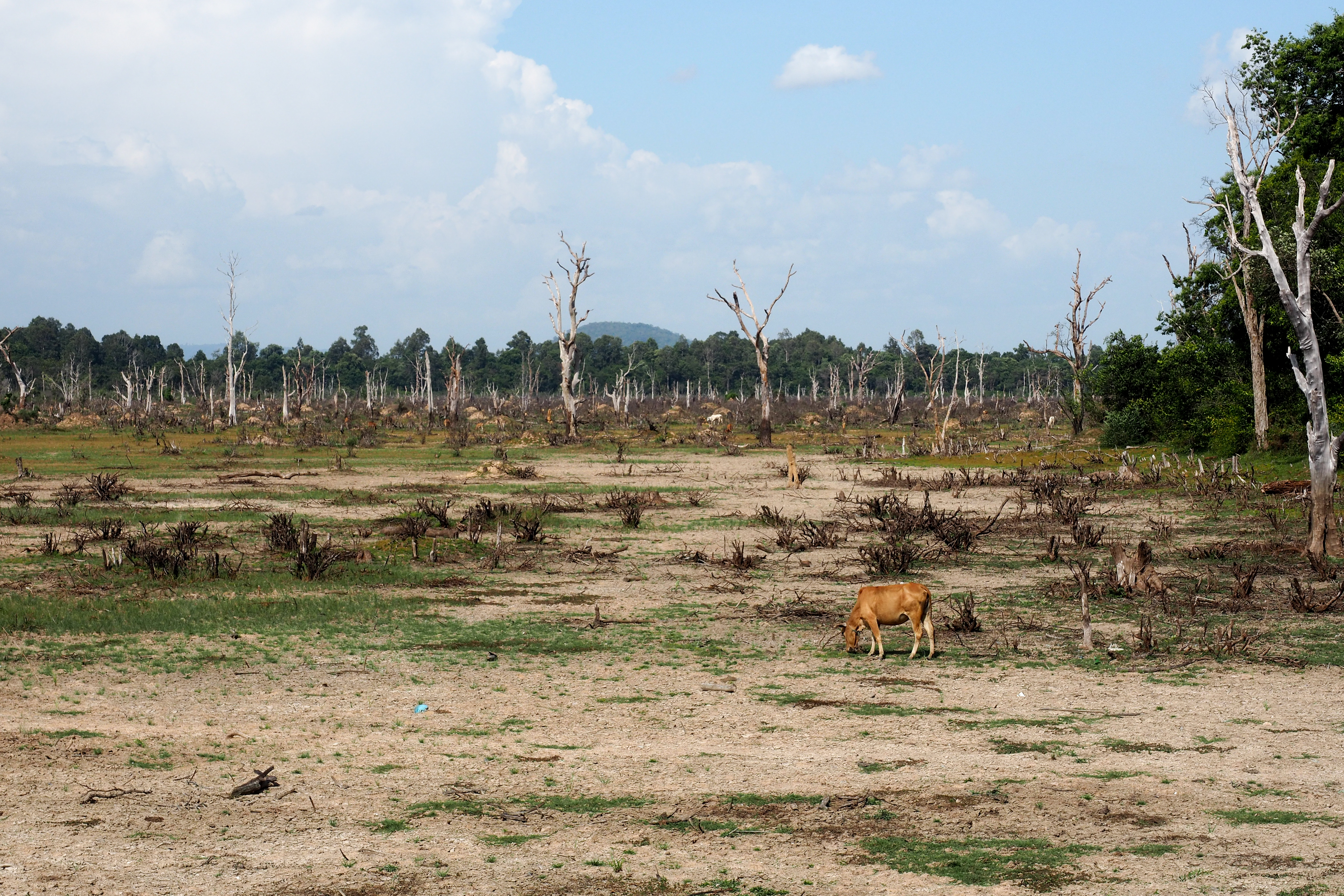
A cow grazing on deforested land, 2019
In May 2025, the EU Commission launched a public consultation on its proposal to remove leather hides and skins from the scope of the EU Deforestation Regulation (EUDR),1 allowing deforestation-linked leather to enter Europe freely.
Over 2000 concerned citizens and organisations from across Europe and beyond raised their voices to urge the EU Commission to keep leather in the EUDR and focus on implementing the law without delay. Together, these contributions have shown that the public cares about Europe’s impact on forests and wants to see deforesting industries held accountable.
Earthsight’s submission is below.
Earthsight’s submission: EU Commission's proposal to amend Annex I of the EUDR
Earthsight is a UK-based non-profit organisation which uses in-depth investigations to expose the links between global supply chains and environmental and social crimes. We have published numerous reports highlighting the role of EU demand in driving global deforestation and have monitored the implementation of the European Timber Regulation (EUTR) since our inception.
Earthsight strongly supports the EUDR and its full, timely implementation. The regulation represents a landmark commitment by the EU to ensure that its consumption does not drive deforestation, ecosystem destruction or associated human rights abuses. A coherent approach to the product scope, covering raw commodities and their derived and transformed products, will drive systemic change across supply chains, secure a level playing field for industry and provide certainty for EU consumers and trading partners.
Earthsight submits the feedback below to the European Commission’s call for feedback on its proposal to amend Annex I of the EU Deforestation Regulation (EUDR).
Leather should be kept in the EUDR
The evidence linking EU leather consumption to deforestation is substantial and irrefutable. The Commission’s proposal to exempt leather (raw and prepared cowhides under Harmonized System (HS) codes 4101, 4104, and 4107) is unjustifiable. The proposal risks significantly weakening the regulation and sets a damaging precedent, one that will embolden other sectors to seek similar exemptions.
Excluding cowhides from the EUDR would introduce a clear and indefensible inconsistency: where the meat from a cow raised on recently deforested land would be banned from being sold in the EU, but a leather jacket or car seat made from the same animal is freely available for purchase.
The Commission must not allow this consultation to become a vehicle for further industry-driven scope reductions. We call on the Commission to maintain leather within the scope of the legislation and to ensure that no additional product codes are removed in response to lobbying pressure, whether through this process or any subsequent revision.
Evidence supporting keeping leather in scope
Evidence from NGOs
Multiple independent NGO investigations have documented the exposure of EU leather supply chains to deforestation and human rights abuses, including illegal deforestation in Indigenous territories and protected areas:
- The Hidden Price of Luxury, Earthsight, 2025: linked Italian leather suppliers of luxury fashion brands to illegal deforestation and Indigenous land rights abuses in the Brazilian Amazon.
- Compliance Checker Company Profile: JBS, AidEnvironment, 2025: links JBS’s beef and leather operations in Brazil to seven potentially EUDR noncompliant case studies.
- Hide on the Highway, Rainforest Foundation Norway, 2024: linked ‘Italian’ leather to imports of Brazilian hides exposed to recent deforestation (after 1 January 2021).
- Cash Cow, Global Witness, 2022: connected Italian tanneries to slaughterhouses that purchased cattle from ranches operating on tens of thousands of football fields worth of illegal Amazon deforestation.
- Deforestation in the Driver's Seat, Environmental Investigation Agency, 2022: showed links between illegal deforestation and automotive leather supply chains of relevance for the EU.
- Nowhere to Hide, Stand.earth, 2021: linked 100 fashion brands to Brazilian tanneries exposed to risk of Amazon deforestation.
- Driving deforestation, Rainforest Foundation Norway, 2021: highlighted European car companies’ exposure to over a million hectares of deforestation.
- Grand Theft Chaco, Earthsight, 2020: traced leather produced on stolen Indigenous land in the Paraguayan Chaco to the seats of Europe’s luxury cars.
Several of these investigations demonstrate that leather entering the EU market would not have complied with the EUDR had it been in effect at the time. Often, this leather is not just produced on deforested land, but also linked to illegal practices, breaching both the law’s deforestation and legality requirements.
In March 2026, Earthsight published analysis revealing that European leather sector lobbyists have targeted far-right parliamentarians as part of a push to have leather removed from the EUDR's scope, while publicly committing to greater traceability and sustainability. The analysis also confirms that leather imported into the EU continues to be linked to deforestation in Brazil and Paraguay. That same month, 26 NGOs and the largest Indigenous network in Brazil wrote to the Commission to set out their concerns about removing leather from the scope of the regulation. They also shared a briefing which brings together independent scientific evidence on why leather must remain within the scope of the EUDR.
Academic evidence
Peer-reviewed research reinforces the link between leather and deforestation.
A 2026 study in Nature Food found that cattle production for meat and leather was the biggest cause of commodity-driven deforestation in the world between 2001 and 2022, accounting for 42 per cent of the deforestation – an area roughly the size of Spain (~51 million hectares) – and 52 per cent of associated carbon emissions.
Perrine et al (2024) analysed embedded deforestation in leather and rubber, and estimated that the EU demand for hides is responsible for the loss of up to 31,000 hectares of forests annually.
Two studies published in Forests, a peer-reviewed journal on forestry and forest ecology, focused on the ways in which the Italian leather sector influences deforestation in Brazil. Mammadova et al (2020) concluded that:
…despite the largely claimed statement by the Italian tanneries, Italy does import from deforestation frontier states, whether it is in the form of direct flows from BLA [Brazilian Legal Amazon] states to Italy or through re-exports from the southern and south-eastern states. Thus, the Italian leather trade with Brazil possesses the risk of Amazonian deforestation, unless the proper traceability and due diligence systems are in place to claim the opposite.
A 2022 follow-up study by Mammadova et al analysed the complex ways in which regulation in consumer markets and international consumption place pressures on producer markets that in turn drive environmental destruction. The leather trade between Italy and Brazil was mentioned to illustrate these dynamics.
The Commission’s own analysis supports keeping leather in the EUDR
The Commission's own staff working document shows that removing leather undermines the objectives of the regulation and makes a compelling case for maintaining leather within its scope. The document reveals that EU consumption of leather has a higher deforestation footprint than that of most other commodities covered by the EUDR – higher than beef, soy or palm oil.2 Keeping leather in scope, according to the Commission's modelling, could generate up to €2 billion per year in environmental benefits. This is 117 times larger than the relatively small annual compliance cost of €16.7 million. No other commodity analysed in the document for inclusion or removal has as high a ratio of benefit to cost as leather.
The analysis also acknowledges leather's role in driving deforestation, noting that “the income from hides and skins keeps prices for meat slightly lower, supporting higher meat consumption and thereby more deforestation.”3 It further states that in some large slaughterhouses, leather has been reported to account for up to 26 per cent of total earnings.4 This directly contradicts the Commission's own rationale that the relatively low economic value of cattle skins and hides means EU operators have limited leverage to demand the information needed to comply with the regulation.
The Commission's methodology leading to its proposal to exclude leather also warrants scrutiny. Based on Figure 17 of the staff working document, two of the three leather hide and skin codes passed all quantitative criteria. Only one failed the Commission’s Path 1 assessment, yet other commodity codes that also failed Path 1 were ultimately proposed to be added to the regulation's scope (see, for example, HS 2916 19 10). Given that leather hides scored strongly on the benefit-cost ratio and that two of the three codes cleared all quantitative hurdles, it is unclear why the Commission weighted the qualitative assessment so heavily in reaching its conclusion to exclude leather.
Some industry members have themselves called for the inclusion of leather-derived products within the EUDR’s scope, to avoid the risk of production relocating outside the EU. The Commission has already demonstrated a willingness to adjust Annex I by proposing to add new derived products. If the Commission is concerned about leather production relocating overseas, the coherent response would be to extend the EUDR’s scope to finished leather goods, not to remove raw hides from it.
At any rate, the prestige of the ‘Italian leather’ brand, with its reputation for quality, also acts as an incentive for companies to continue to manufacture leather goods in the EU. Italy is the world's largest market for Paraguayan leather and second largest for Brazilian leather.5 The volumes involved are substantial and gives overseas suppliers a strong commercial incentive to retain access to this lucrative market. That leverage works in EU leather operators' favour and suggests they may be underestimating their own ability to obtain the due diligence information the regulation requires.
Industry readiness and appetite for compliance
Consumer-facing brands have themselves acknowledged the link between leather and deforestation. Major fashion and automotive companies have made public commitments to eliminate deforestation from their supply chains. Multiple brands, from BMW to H&M, have signed onto the Deforestation-Free Call to Action for Leather, which recognises the influence that leather consumption in Europe and other northern markets has on the deforestation and conversion of natural ecosystems associated with cattle ranching.
The EUDR is already incentivising producers to invest in traceability to support continued exports of both beef and leather, with multiple schemes in development or already in operation. Brazil, Argentina and Paraguay are all working on cattle traceability systems that would make it possible to verify where animals came from. The EUDR has been a key motivation for that work. Dropping leather from the EUDR risks stalling that progress in its early stages.
The leather sector can build on progress already made in the wider cattle sector towards EUDR compliance. European leather tanneries already source most of their leather from regions with functioning cattle traceability. Their compliance costs would be lower than assumed, since many of its upstream suppliers will need to meet the regulation’s requirements for beef exports in any case.
It is already technically possible and commercially viable to scientifically test leather to help determine its origins. In fact, several companies using leather in their supply chains already do so.6
Where parts of the leather supply chain face compliance difficulties, the appropriate response is to provide support and time, not to remove leather from the law entirely. Exempting leather would reward those who have resisted necessary changes while penalising stakeholders that have diligently invested in traceability and prepared in good faith for implementation.
Exempting leather would undermine the EUDR's effectiveness, coherence and credibility
The environmental and human rights costs of exempting leather are concrete and significant. Voluntary sector commitments have consistently failed to deliver meaningful progress on traceability or deforestation. This is evidence that regulatory obligations are necessary, not optional. The question therefore should not be whether it is politically convenient to regulate leather but whether Europe is serious about ensuring that its consumption does not incentivise deforestation and associated illegalities.
Removing leather from the regulation does not make the sector’s deforestation links disappear. It simply removes accountability and signals to other sectors that persistent lobbying, not evidence, determines the scope of EU environmental laws.
The European Commission itself affirms EU consumption of leather drives tens of thousands of hectares of deforestation every year. It is clear that removing the commodity from the EUDR is not compatible with or proportionate to the law’s objectives.
New data reveals that the world lost 4.3 million hectares of tropical primary forest in 2025 – equivalent to almost 11 football fields per minute – with agricultural expansion being the leading cause. Full implementation of the EUDR, without further delays, weakening through 'simplification' measures or reopening of the legal text, is essential to ensure the regulation can effectively protect forests, biodiversity and Indigenous rights.
To meaningfully reduce Europe’s impact on global deforestation, as the EUDR is intended, the European Commission must not provide a market for forest-risk leather. We urge the Commission to withdraw its proposal to remove leather from Annex I.
Notes
1 The Commission proposed several amendments to Annex 1, the part of the law that lists the commodities and derived products to be covered by the regulation. Among these proposed amendments was the removal of leather from the scope of the law.
2 Page 11 of the Commission staff working document, Figure 6: Annual deforestation footprint per commodity in the period 2015-2020.
3 Page 17 of the Commission staff working document, Footnote 12.
4 Page 17 of the Commission staff working document, Footnote 13.
5 According to shipment data analyses conducted by Earthsight.
6 According to industry sources who talked to Earthsight.