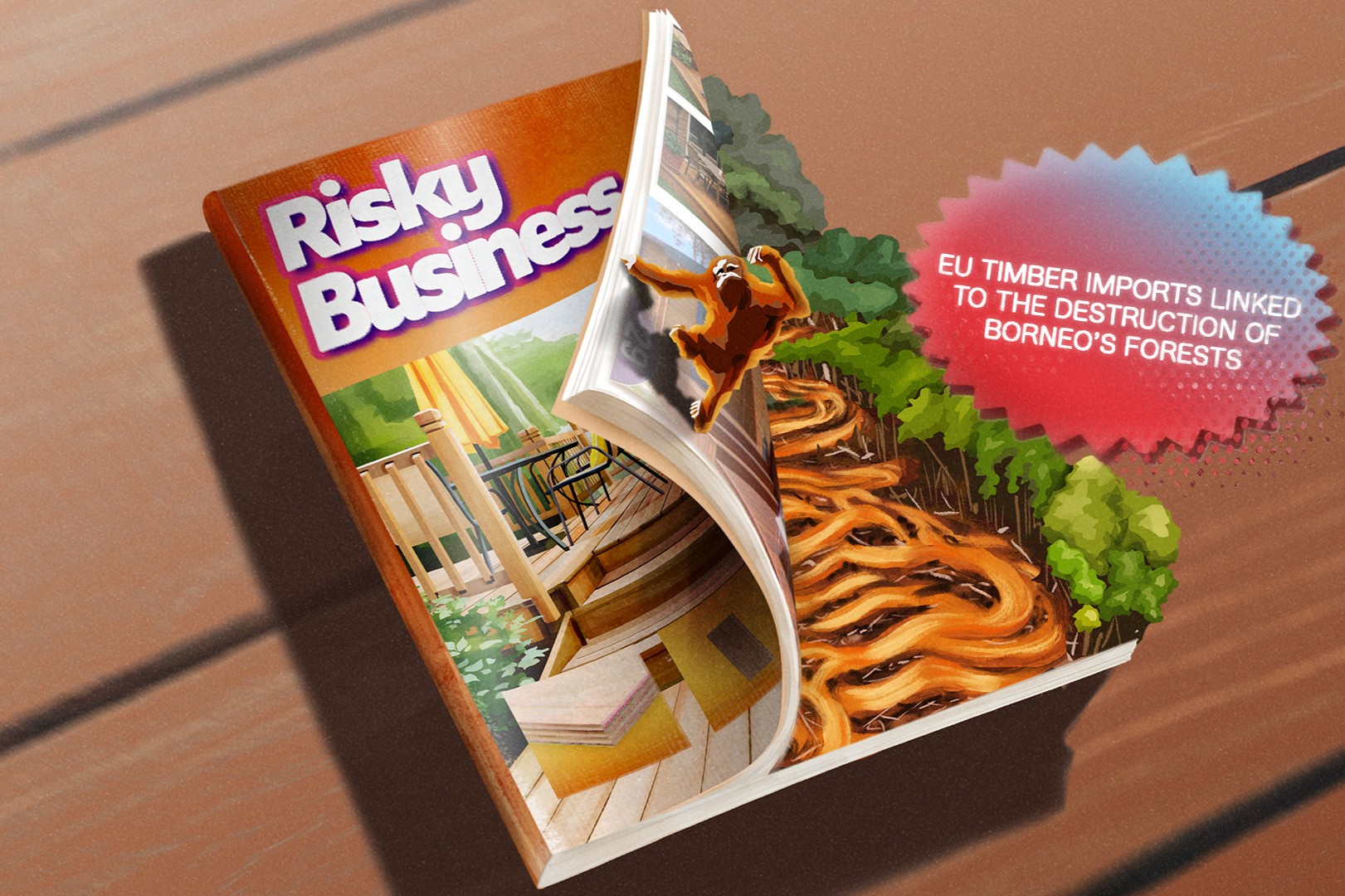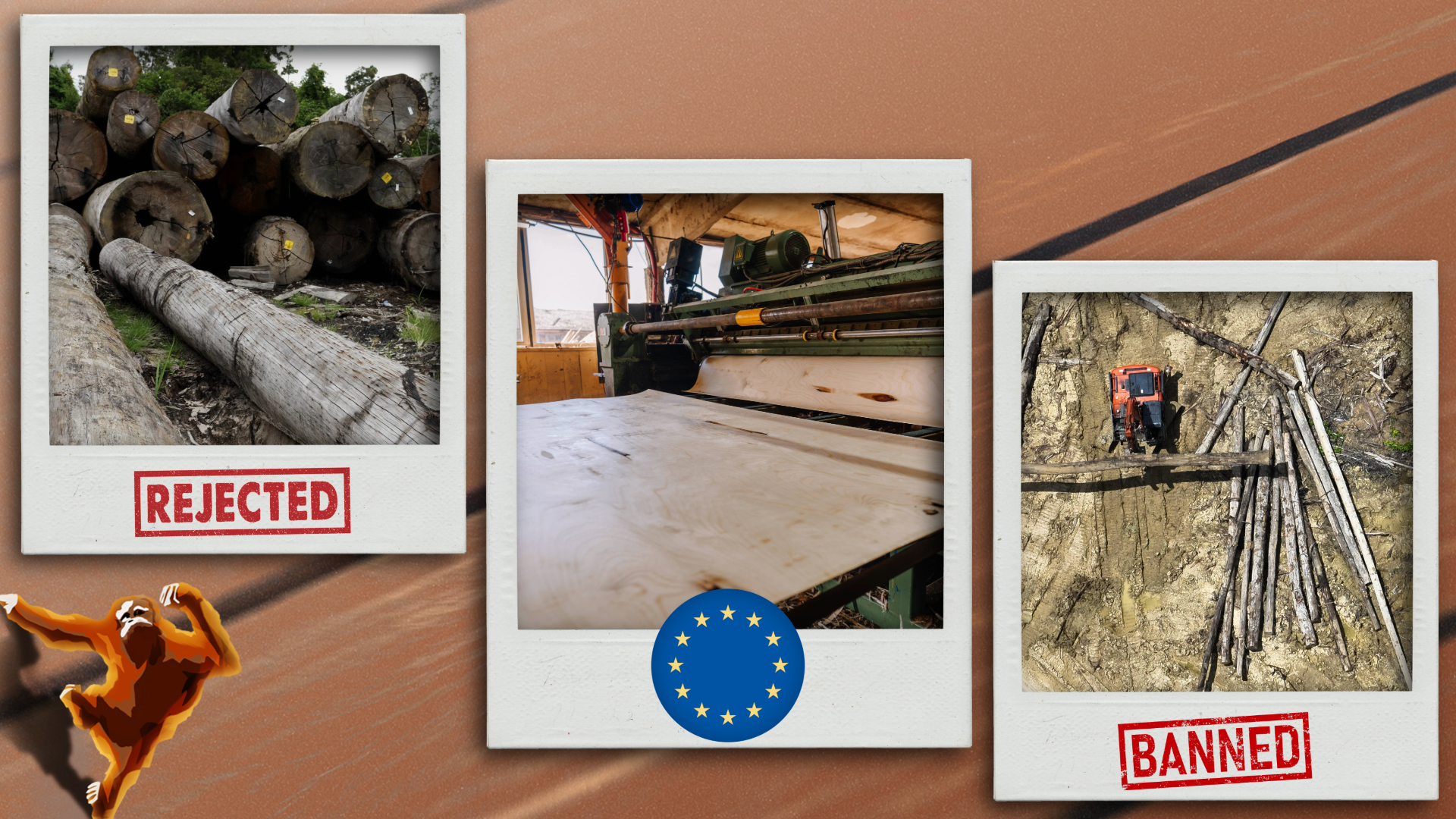
- In October 2025, Earthsight and Auriga Nusantara published Risky Business, which exposed Indonesian timber companies buying wood produced through the destruction of orangutan habitat in Borneo and selling on to international markets, including the EU
- Since then, several companies named in the report have taken significant steps to exclude this ‘deforestation wood’ from their supply chains – and therefore align with the EU Deforestation Regulation (EUDR), which will from December 2026 ban imports of commodities linked to forest clearance or illegality
- This new research shows that the EUDR has already had a huge impact in making Europe’s timber trade more sustainable, and that many EU companies are well prepared for its implementation
- However, very high-risk EU imports have continued, including from an Indonesian plywood producer which in 2024 sourced almost all of its tropical timber from deforestation in Borneo. Its customers in 2025 included an Italian manufacturer of hardwood panels used in motorhomes
- This underlines exactly why the EUDR is needed: demand for and trade in the products of deforestation persist, even as individual companies raise their game. Only regulation can bring about the systemic change required to truly tackle forest loss
New research from Earthsight and Auriga Nusantara has found that several key players in the Indonesia-EU timber trade have taken steps to clean up their supply chains and exclude timber linked to deforestation, after our report Risky Business highlighted trade in wood produced through destruction of precious forests. These new developments demonstrate the huge potential of the upcoming EU Deforestation Regulation (EUDR) to drive more sustainable commodity production worldwide.
Yet our analysis also identified Indonesian companies that continued to use wood from deforestation in oil palm and timber plantation concessions in 2025, while exporting wood products to the EU. One company, which in 2025 bought more than 19,900 cubic metres of wood from deforestation in Borneo, sold hardwood plywood to an Italian business that supplies all major European manufacturers of recreational vehicles (RVs).
This underlines exactly why the EUDR is needed. From December 2026, the new regulation will require importers of forest-risk commodities such as palm oil, rubber, coffee and wood to trace their goods to the point of origin and ensure they did not come from land that was deforested after 2020. Timber produced through the ‘conversion’ of natural forest to other land uses, such as plantations that feed the palm oil or pulp and paper industries, will therefore be illegal to import into the bloc.
This new research raises the alarm for all EU importers of Indonesian wood: as long as they buy from companies processing wood linked to deforestation, their supply chains are at high risk of future non-compliance with the EUDR. Violating the regulation will incur heavy penalties, including a fine of up to 4 per cent of annual EU-wide turnover. The remainder of 2026 represents a crucial final opportunity to clean their supply chains of tainted timber.
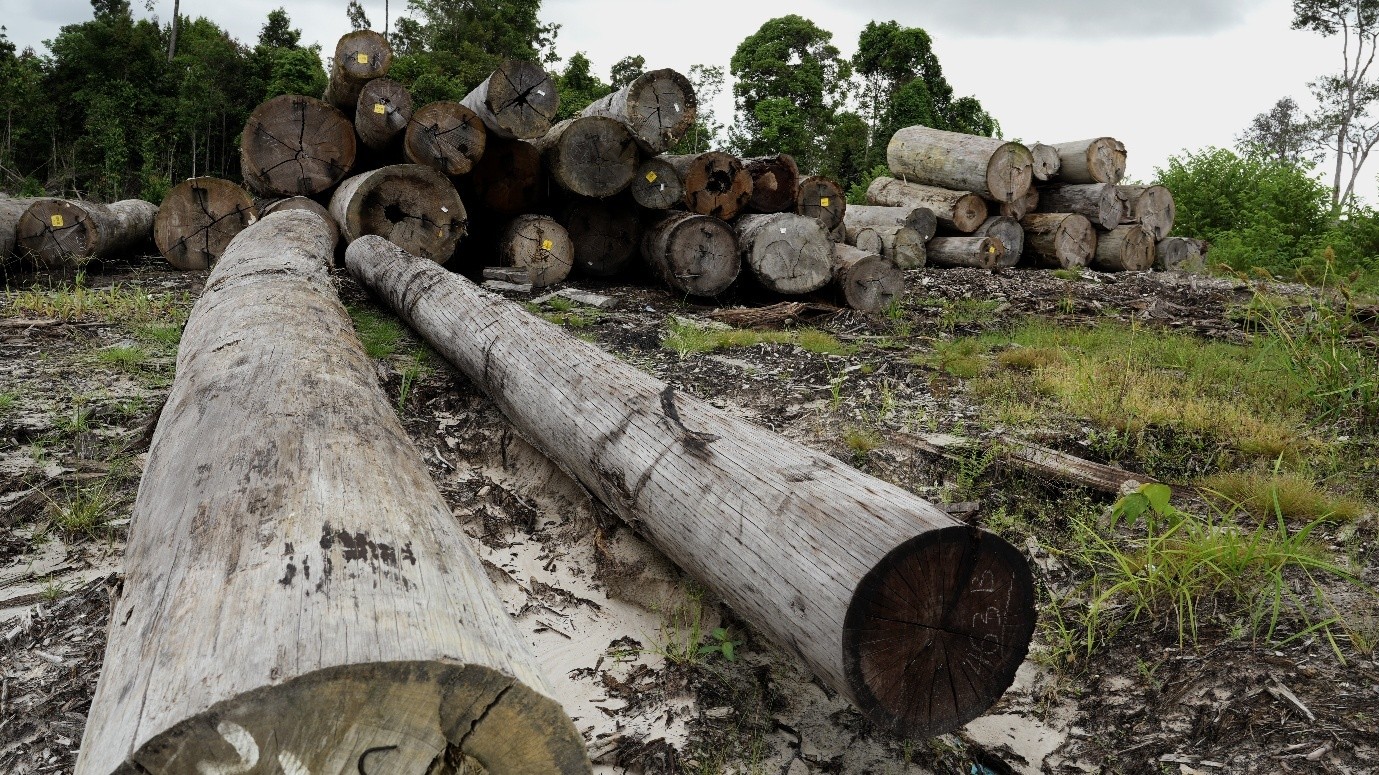
Logs from natural forest cut down in the PT Bina Sarana Sawit Utama oil palm concession in Central Kalimantan, Borneo, November 2024. The yellow labels indicate the logs have been legally recorded within Indonesia’s timber traceability systems
Positive steps show impact of the EUDR
Earthsight and Auriga Nusantara’s October 2025 report Risky Business shone a spotlight on trade in some of the least sustainable timber in the world. It exposed how logs produced through the permanent destruction of natural forest in Borneo – including habitat for the Critically Endangered Bornean orangutan – were being bought by major timber processing companies in Indonesia and sold on to international markets including the EU.
Many of the key players identified in Risky Business have since taken significant steps to reduce their exposure to this ‘deforestation wood’, in a striking example of the EUDR’s positive impact even before it is enforced.
PT Korindo Ariabima Sari was in 2025 the second biggest exporter of timber from Indonesia to the EU.1 In 2024, the company purchased 14,497 cubic metres of deforestation wood, representing 8 per cent of its total wood supply, from clearance in the concession of PT Indosubur Sukses Makmur, on the eastern tip of Borneo. That year, an area of rainforest bigger than New York’s Central Park, or three times the size of Hyde Park in London, was destroyed in the concession to make space for plantations.
In response to the publication of Risky Business in October 2025, PT Korindo Ariabima Sari stated that they had permanently ceased buying timber from PT Indosubur Sukses Makmur and its distributor.
In an email to Earthsight and Auriga in March 2026, president director Kim Young Man wrote: “PT Korindo Ariabima Sari is committed to ensuring that our entire timber supply chain is free from deforestation. We continue to strengthen our procurement system to be transparent, responsible and aligned with global regulations, including the EUDR, as part of our commitment to environmental sustainability.”
PT Kayu Multiguna Indonesia, the fourth biggest exporter of timber from Indonesia to the EU in 2025,2 had in 2024 sourced 9 per cent of its raw timber from deforestation in Borneo, including in the oil palm concession PT Bina Sarana Sawit Utama.
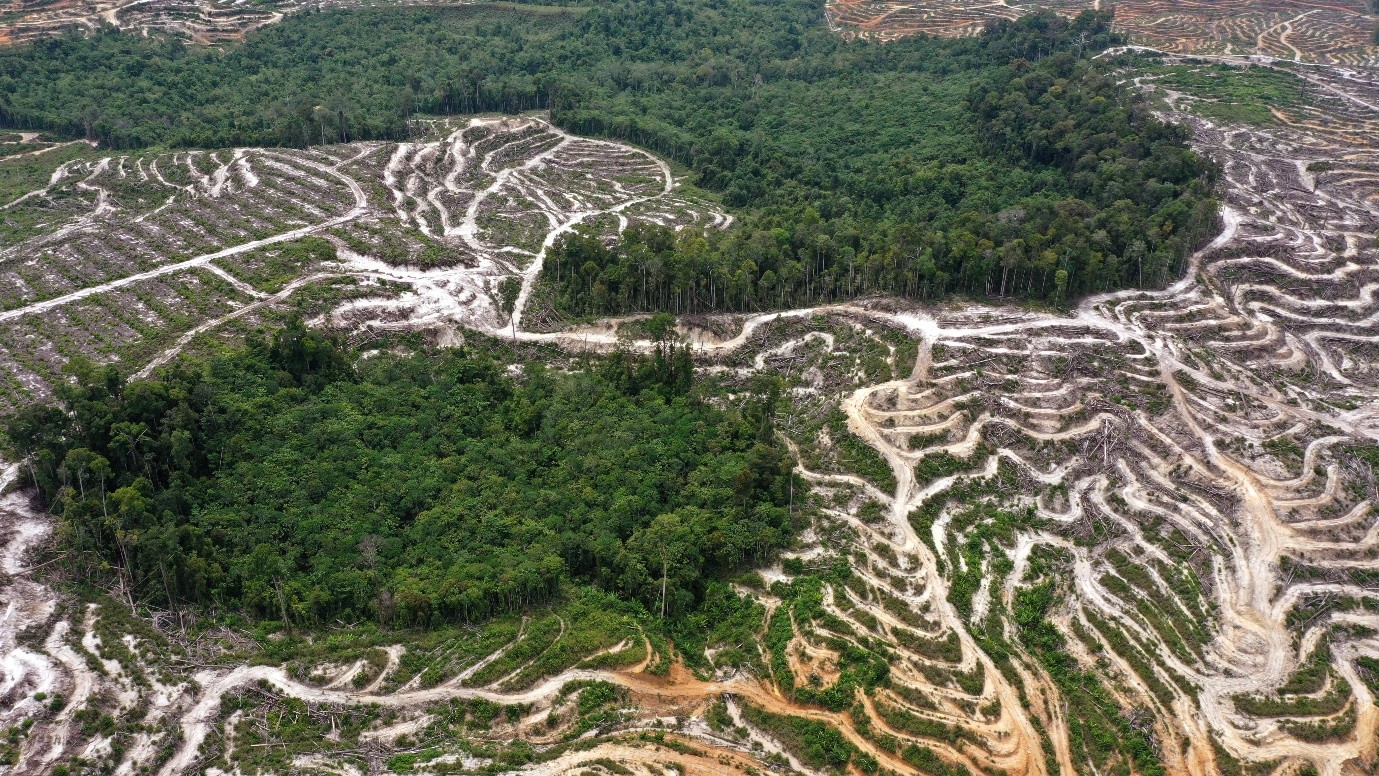
Forest clearance in the concession of oil palm plantation company PT Bina Sarana Sawit Utama, Central Kalimantan, Borneo, November 2024
In an April 2026 email to Earthsight and Auriga, the company stated that in 2025, all of its natural forest logs (as opposed to wood from plantations) came from FSC-certified concessions in Maluku province, and that they bought no wood from deforestation that year. We have been unable to access documentation to independently verify this claim.
PT Kayu Multiguna Indonesia stated: “In exporting to the European Union, the company collects the necessary information and provides a Due Diligence Statement (DDS) to ensure that the wood products marketed meet legal requirements and relevant provisions of the EUDR.”
Meanwhile in the EU, Belgium-based Fepco International, the biggest European importer of Indonesian plywood,3 has implemented our recommendation to cease doing business with any supplier that uses wood from deforestation. The company now includes a clause in its contracts with suppliers, requiring them to commit to not using any deforestation wood, and stating that doing so would be regarded as a contractual breach.
Fepco’s managing director Alexander de Groot explained in an interview with Earthsight: “Even if not used for products produced for us we would […] stop the cooperation simply because we don't want to be connected in any way with suppliers involved in deforestation.” He added: “We want to be recognised in the market by our customers that doing business with Fepco should be zero risk.”
Fepco told Earthsight that the company is already following the EUDR’s requirements ahead of it being enforced. Logistics and operations coordinator Herman de Smedt explained: “We are having them [suppliers] upload harvesting licenses, transport documents, GPS coordinates, and having that fully checked already. So we're no longer just accepting a V legal [certificate of legality], even though technically that would be sufficient [under current legislation].”
The Dutch timber importer Dekker Hout told Earthsight that after receiving a copy of Risky Business, the company suspended contracts with the suppliers mentioned in the report and initiated a thorough internal review. Managing director Olaf van Biezen wrote in March 2026: “Dekker Hout operates under strict due diligence procedures and is fully committed to compliance with all applicable legislation, including the EU Timber Regulation (EUTR) and the upcoming EU Deforestation Regulation (EUDR).”
These actions mark significant steps by these companies to reduce their exposure to deforestation wood, and thus EUDR non-compliance. With every European importer that refuses to do business with a company using deforestation wood, and with every Indonesian timber processor that excludes this wood from their supply, the market for this ecologically destructive commodity shrinks. As this happens, the profitability of forest conversion shifts, and the future of Indonesia’s remaining forests starts to look more secure.
In these cases, companies acted at least in part because of information shared by Earthsight showing that their suppliers were purchasing deforestation timber. Once the EUDR is in effect, it will require companies to proactively identify any deforestation in their supply chains, rather than waiting for an exposé or NGO report.
These examples show the power and impact of the EUDR, even before it is fully in effect: by turning association with deforestation into a high-risk activity that could mean losing access to one of the world’s biggest markets, it is transforming the baseline of sustainability in global commodity production.
Risk from deforestation wood continues
Despite this progress, some companies in the EU continue to import wood that is linked to deforestation in Indonesia. New Earthsight analysis of Indonesian trade records for 2025 has identified imports from high-risk suppliers who are heavily dependent on deforestation wood.
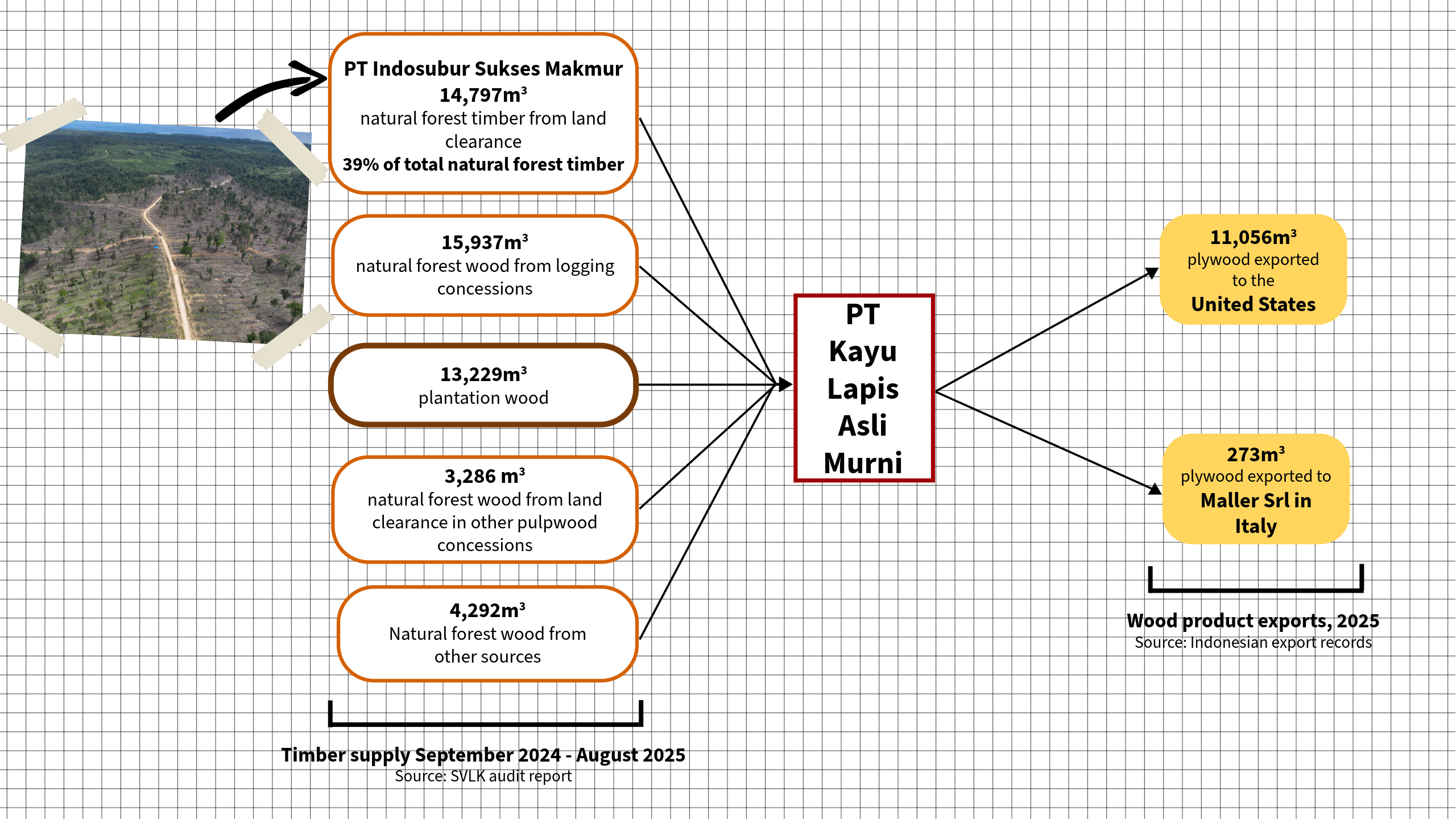
In 2024, the Indonesian plywood producer PT Kayu Lapis Asli Murni (PT KLAM) sourced 87 per cent of its natural forest logs from forest clearance in the concession of PT Indosubur Sukses Makmur (PT ISM) in East Kalimantan, a total of 17,853 cubic metres (m3). Earthsight and Auriga profiled the company in our August 2025 report Unhappy Campers, which focused on its sales to the US recreational vehicle (RV) industry.
Our new research once again leads to the RV industry, though this time in Europe. The Italian company Maller Srl, which manufactures wood-based panels used in mobile homes, motorhomes, campervans and furniture, imported 273m3 of meranti plywood from PT KLAM in 2025, according to Earthsight analysis of shipment records.
Meranti is a type of hardwood tree which grows only in natural forests. Meranti plywood, also known as lauan, is widely used in the manufacture of RVs, as detailed in Unhappy Campers. A caravan industry magazine reported that Maller Srl supplies wood-based panels to almost every European manufacturer of RVs.
Our analysis of official wood sourcing reports and audit reports published under Indonesia’s SVLK timber legality assurance system shows that PT KLAM continued to buy wood from clearance in the PT ISM concession in 2025, receiving 16,618m3 of natural forest logs that year.4
Satellite imagery analysis shows that extensive deforestation continued in the PT ISM concession in 2025, with more than 400 hectares of forest destroyed. Intensive logging was undertaken across an area of approximately 1800 hectares of primary forest, creating immense damage to a previously untouched ecosystem. Logging and road building have continued in the first months of 2026.
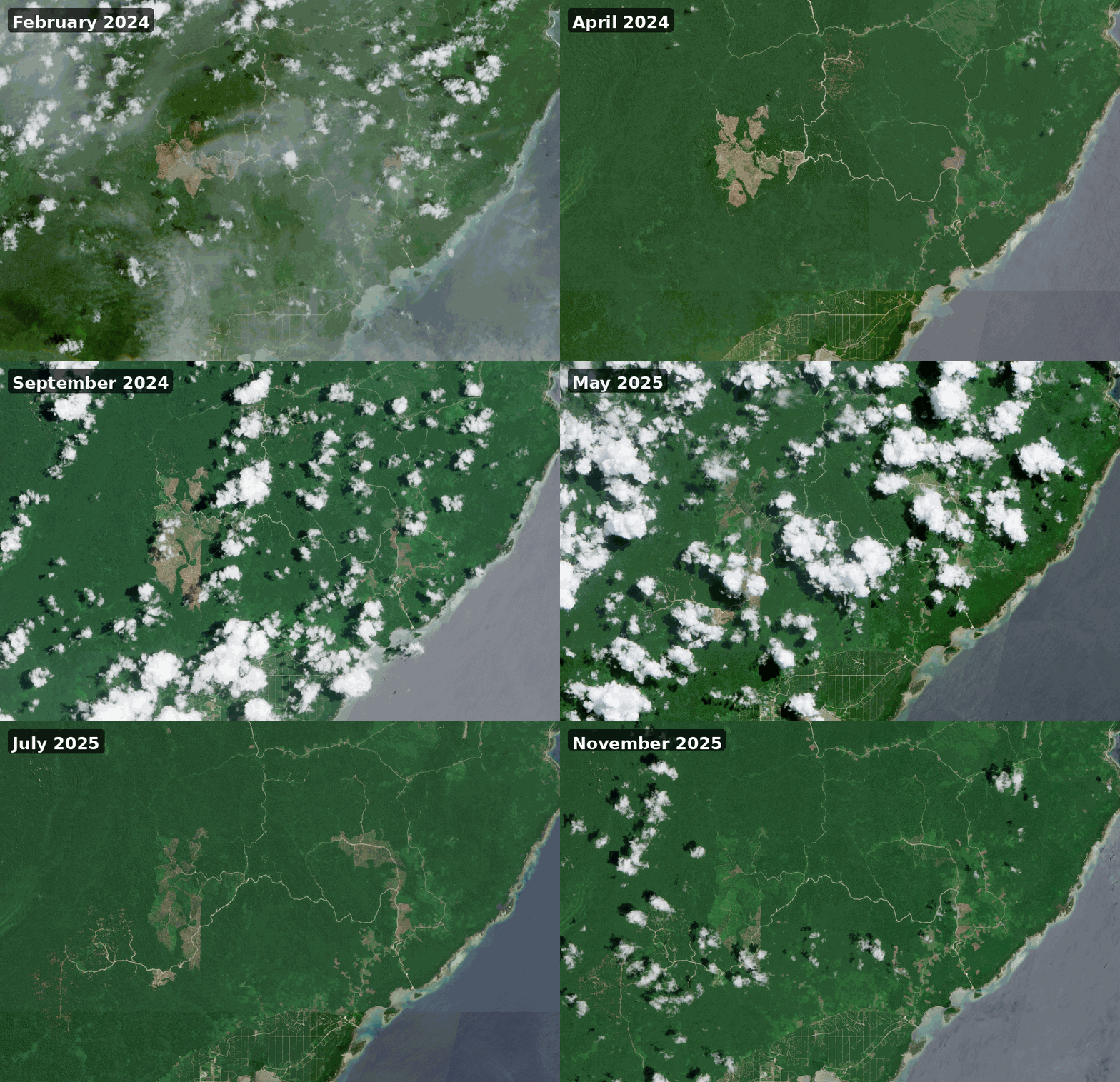
Deforestation in the concession of PT Indosubur Sukses Makmur, East Kalimantan, February 2024–November 2025 © Earthsight / Auriga. Image source: Sentinel-2 via Copernicus Browser
Any imports of wood products from PT KLAM in 2025 were therefore at extremely high risk of containing deforestation wood, which would be non-compliant with the EUDR when it is enforced.
There is no indication that the wood used by PT KLAM was illegally sourced, or that it or its customers in Europe have violated the current EU Timber Regulation (EUTR), which requires importers to establish that wood products were obtained legally. The EUDR will replace the EUTR from December 2026. As our research has underlined, Indonesian law allows the sale of timber produced through clearance of natural forest if the companies involved have the correct permits and comply with the requirements of the country's SVLK timber legality assurance system.
In an emailed response to Earthsight and Auriga, Maller Srl stated: “Our company operates in full compliance with current regulations regarding the timber trade, including the obligations set forth in the EUTR Regulation […]. With regard to the EU Deforestation Regulation (EUDR), we emphasise that it is not yet fully applicable. However, our company is closely monitoring regulatory developments and evaluating the necessary measures to ensure future compliance.”
PT KLAM had not responded to Earthsight and Auriga’s requests for comment at the time of publication.
EU companies say they are ready for the EUDR
Adopted in 2023 and initially scheduled to be enforced from December 2024, the EUDR has twice been delayed. The regulation was also weakened in a 2025 revision, which in particular reduced obligations on retailers and other companies that re-sell commodities after they have been imported into the EU.
The EU Commission has now been tasked with undertaking a ‘simplification review’ of the law and reporting back to the European Parliament and Council by 30 April 2026. The Environment Commissioner has indicated that the Commission does not favour another reopening of the EUDR and instead intends to “simplify” the law through guidance and delegated acts.
While some industry bodies and companies in the EU, as well as the Trump administration in the US, are calling for further weakening of the regulation, many European businesses are supportive of it, well-prepared for its implementation and frustrated by ongoing unpredictability.
On his company’s preparedness for the EUDR, Fepco’s Alexander de Groot said: “In short, we are ready for it, and ready to adjust our sourcing to whatever is necessary to make sure that everything we get is confirmed [compliant].”
Commenting on the repeated delays to the regulation, he added: “It’s frustrating that in the whole sector, people have been preparing themselves and investing money in software systems, labour, manpower […]. So after all these delays, nobody in my opinion can still say ‘I was not ready for it’.”
In an email to Earthsight, Dutch timber importer Dekker Hout wrote: “We support the objectives of the EUDR and believe it will contribute to improved sustainability, transparency, and accountability within the global timber sector.”
Our findings highlight how impactful the EUDR has already been in driving shifts towards due diligence and sustainability in the timber industry. But they also underline that trade in the products of deforestation is still happening. Until the EUDR is fully in force, we will continue to see EU companies importing products linked to the destruction of precious forest ecosystems overseas.
European businesses must act now to clean up their supply chains if they are to avoid sleepwalking into non-compliance with the EUDR. And only full enforcement of the regulation can ensure an end to this tainted trade.
Our recommendations
EU timber importers should:
- Demand that Indonesian companies seeking to supply wood to the EU market do not purchase any wood from deforestation
- Conduct immediate checks to establish the concessions in which their timber was harvested, what other concessions their suppliers sourced timber from, including via middlemen companies, and whether any deforestation has taken place in these concessions since December 2020
- Cancel contracts with Indonesian timber suppliers found to have deforestation timber in their supply
- Recognise that SVLK/FLEGT licences do not guarantee that Indonesian timber is deforestation-free and therefore EUDR-compliant
- As a starting point, commit to only purchasing wood that is independently certified as legal, sustainable and deforestation-free by FSC under its new, stricter EUDR-compliance standard. However, due to known flaws in FSC systems, they must avoid relying on FSC or other voluntary certification schemes alone as evidence of compliance with the EUDR, and conduct thorough due diligence of their own
- Demand full traceability from their timber suppliers, including middlemen companies, using tools such as audits, scientific testing and unannounced on-site inspections to verify claims
The European Commission, Parliament and Council should:
- Reject any attempts to further delay or weaken the EUDR
- Push for the full implementation of the EUDR at the end of 2026
Indonesian timber companies should:
- Stop buying any wood derived from conversion of natural forest, whether for plantation forest, oil palm or other agriculture, mining, or infrastructure projects
- Publicly state their rejection of deforestation wood
- Proactively share timely and accurate information on all their sources of timber with current or potential European customers in order to facilitate due diligence required under the EUDR and enable EU companies to identify suppliers that do not use any deforestation wood
The Indonesian government should:
- Issue a regulation that provides legal protection for all remaining natural forest in the country, including in concessions and on private land, which would mean any deforestation in Indonesia would be categorised as illegal
- Improve Indonesia’s SVLK timber legality assurance system in order to
- ensure SVLK does not certify as sustainable any timber from deforestation;
- improve transparency, including ensuring civil society access to key documents and systems such as timber sourcing and selling reports (RPBBIs), reports on government revenue from the timber industry (SI-PNBP v2), and the SIPUHH timber trade administration system; and
- provide safe and adequate space for independent forest monitors within SVLK processes
Notes
1 Earthsight analysis of Indonesian export records for 2025, HS code 44
2 Earthsight analysis of Indonesian export records for 2025, HS code 44
3 Earthsight analysis of Indonesian export records, 2024 and 2025
4 We have been unable to access the documents needed to assess all of PT KLAM’s wood supply in 2025, which is symptomatic of a worsening lack of transparency in Indonesia’s timber trade. A decree issued by the secretary-general of Indonesia’s Ministry of Forestry and Environment in May 2024 specifically revoked public access to a large number of key documents, including reports on companies’ raw log usage and their origins, despite an EU-Indonesia agreement on timber trade (VPA) mandating that these be made available for independent monitors