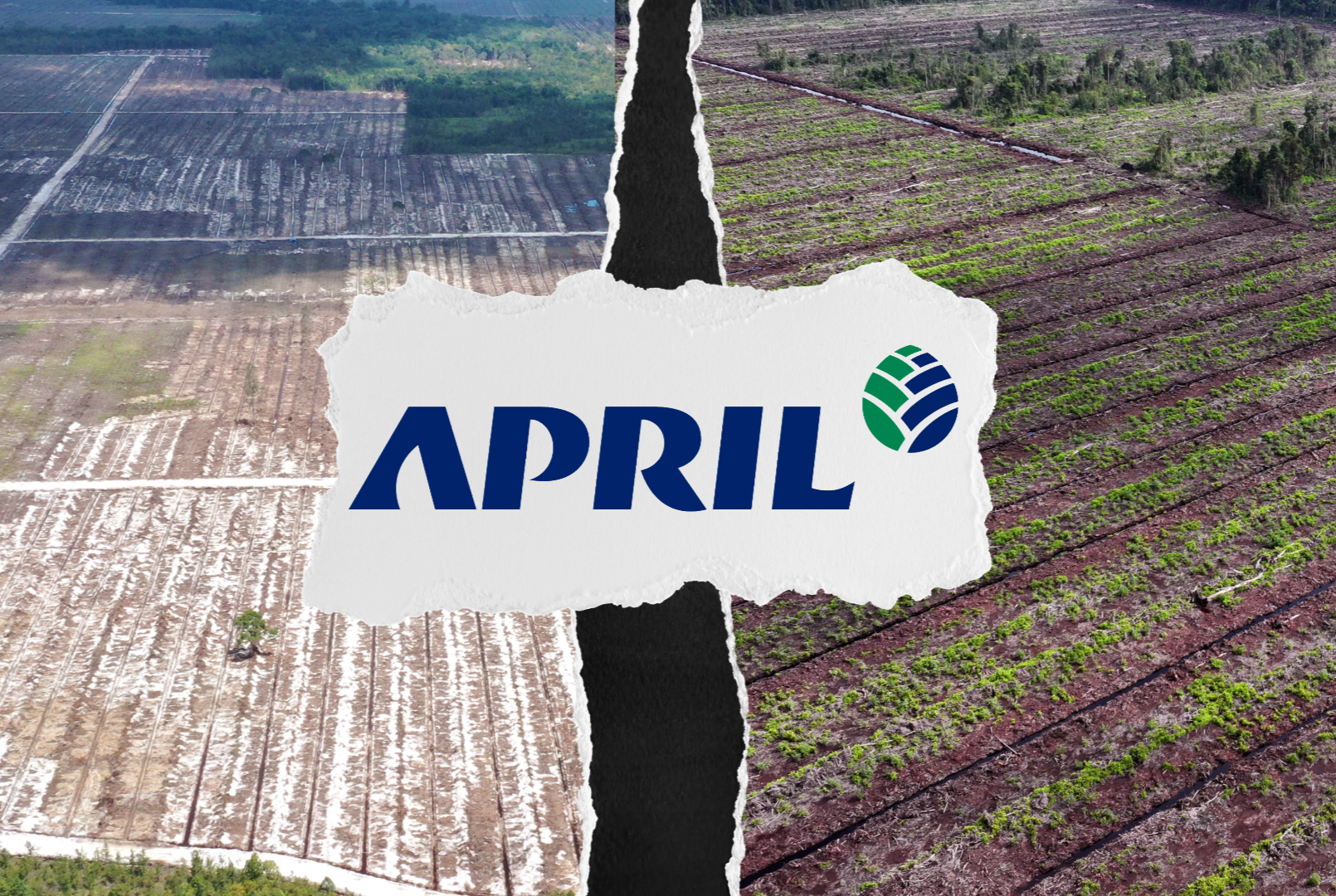
Left: Cleared land in the concession of PT Industrial Forest Plantation, November 2024. Right: Recently cleared areas of peat forest in the concession of PT Mayawana Persada, 2024
- Pulp and paper giant APRIL has added Indonesia’s two worst deforesters to its list of approved suppliers
- APRIL says it will now buy wood fibre from timber plantation companies PT Mayawana Persada and PT Industrial Forest Plantation, which have together cleared more than 47,000 hectares of precious tropical forest since 2020
- APRIL’s move could mean it is unable to sell its products to EU markets after 30 December 2026, when the EU Deforestation Regulation is enforced
- APRIL has also amended an internal policy that stopped it buying wood harvested on land deforested after 2015. The revised policy moves this 'deforestation cut-off date' to December 2020
- Twenty-three NGOs have condemned the decisions, calling on APRIL to uphold its sustainability commitments and reject suppliers linked to deforestation. They argue that buying from suppliers linked to recent deforestation could end APRIL’s hopes of regaining certification under leading green label Forest Stewardship Council
Indonesia’s second-biggest producer of pulp and paper, Asia Pacific Resources International Limited (APRIL), has welcomed two of the country’s worst deforesters as new suppliers of wood fibre. The decision has been condemned by an international group of NGOs, including Earthsight and Auriga Nusantara.
APRIL confirmed in a letter to Earthsight that it began receiving wood fibre from PT Industrial Forest Plantation (PT IFP) in May 2026, and will add PT Mayawana Persada (PT MP) to its list of approved suppliers in “the coming weeks.” The company then publicly confirmed the moves.
Located in Indonesian Borneo, PT MP and PT IFP rank as the first and second-worst deforesters across Indonesia’s entire plantation sector this decade, having cleared more than 33,000 hectares and 14,000 hectares of precious tropical forest respectively since 2020.
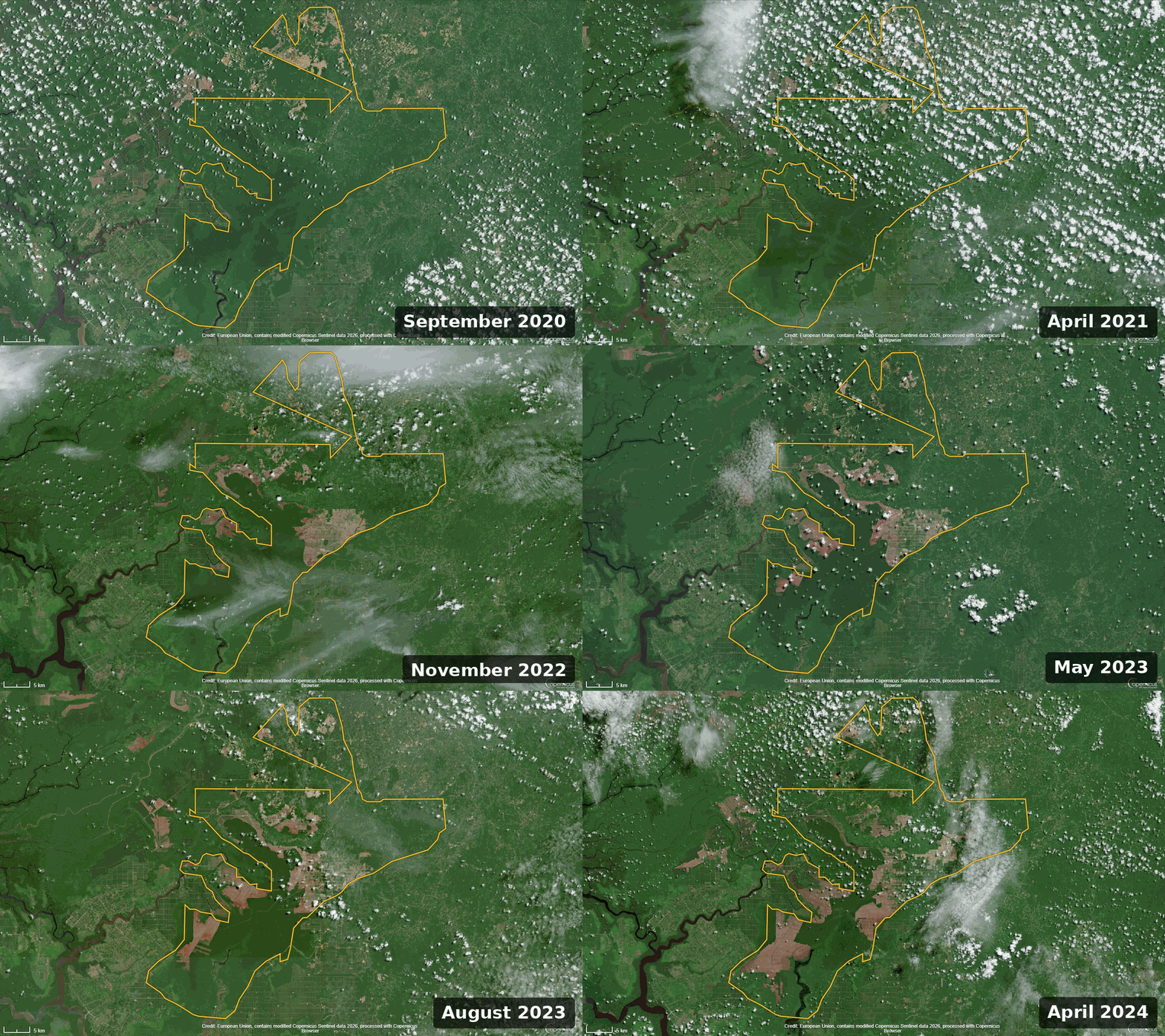
Deforestation in the concession of PT Mayawana Persada, September 2020–April 2024 © Earthsight. Image source: Sentinel-2 via Copernicus Browser
Both companies have destroyed habitat for the critically endangered Bornean orangutan, and are in conflict with local and Indigenous communities. Local community leaders contend that PT MP cleared sacred forest and important agroforestry sites, in contravention of agreements signed with the company. Residents of villages which overlap with the PT IFP concession say fishing and collecting wood have become much more difficult since the company has cleared forest, and that it failed to fulfil promises to provide crops to support livelihoods in the community.
APRIL adopted its Sustainable Forest Management Policy 2.0 (SFMP 2.0) in 2015, which commits it to eliminating deforestation from its supply chains. In May 2026, a statement on the company’s website declared that this policy had been “suspended.” The wording of this statement has since been changed to refer to the policy coming “under review.”
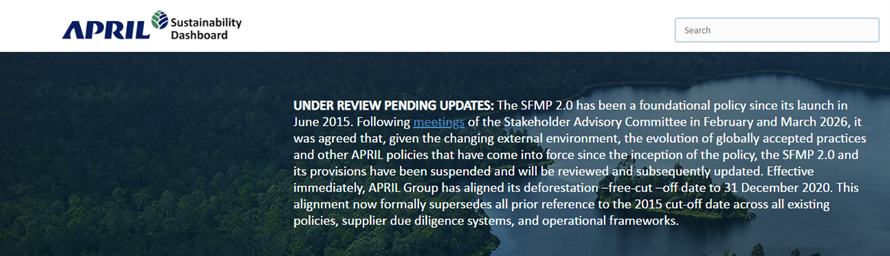
Screenshot from the APRIL website, 22 May 2026
This comes a few months after APRIL changed the deforestation ‘cut-off date’ in its sustainability policies from 2015 to 31 December 2020, opening the door to suppliers that destroyed vast swathes of forest after SFMP 2.0 was adopted. Both PT MP and PT IFP continued to deforest thousands of hectares even after 2020.
On 1 June 2026, a group of 23 NGOs from Indonesia, Europe, the United States and Canada wrote to APRIL to condemn these recent moves. The letter calls on the company to remove PT IFP and PT MP from its list of suppliers and reinstate its sustainable forest policy with the original 2015 cut-off date for deforestation.
The NGO letter argues that the shift in cut-off date “sends a dangerous signal to timber companies that clearing natural forest will not necessarily be a barrier to market access, so long as they wait for sufficient time to pass.”
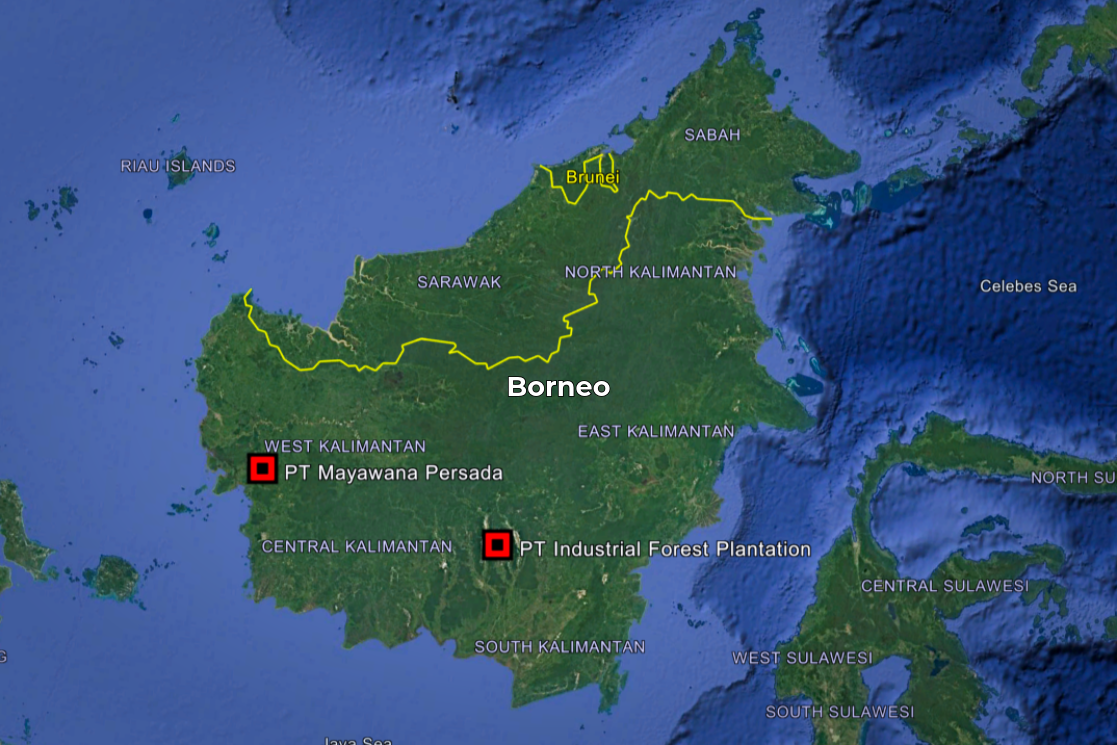
Locations of the concessions of PT Mayawana Persada and PT Industrial Forest Plantation in Borneo
Persistent links to deforestation
APRIL is part of the RGE Group conglomerate, owned by the billionaire Tanoto family. APRIL itself comprises a group of companies which produce and trade a range of paper and cardboard products for global markets, as well wood pulp used for viscose fibre.
In the 2000s, APRIL and its suppliers cleared vast areas of forest in Indonesia to make way for plantations of fast-growing timber to feed its pulp and paper mills. It adopted its Sustainable Forest Management Policy following extensive criticism from Indonesian and international NGOs, and after the Forest Stewardship Council (FSC), the world’s best-known sustainability certification scheme for wood products, cut ties with the company in 2013 over its deforestation activities.
RGE, APRIL and its fibre suppliers have since been repeatedly linked to environmental harm and rights abuses in Indonesia, including extensive allegations that RGE controls a network of ‘shadow companies’ that have cleared forest in recent years. Greenpeace has linked RGE to both PT MP and PT IFP through management personnel, corporate connections and supply relationships. RGE has denied it owns or controls the companies.
In January 2026, Earthsight and Auriga exposed extensive illegal deforestation in the concession of PT Toba Pulp Lestari, a supplier of wood fibre to RGE company Asia Pacific Rayon.
APRIL has said it is now engaging new suppliers because of supply disruptions caused by the Indonesian government revoking permits for 28 companies in January 2026, after deadly flooding hit Sumatra in late 2025.
However, this supply crunch may also be linked to APRIL having substantially increased the capacity of its flagship mill in recent years. NGOs warned that this capacity expansion could drive deforestation in the absence of clear plans for accessing more wood fibre from sustainable sources.
Timber plantations within the concession of PT Industrial Forest Plantation, November 2024 © Auriga / Earthsight
APRIL’s sustainability commitments
APRIL’s Sustainable Forest Management Policy 2.0, adopted in 2015, states that APRIL and its suppliers will not develop forested areas (defined through High Conservation Value (HCV) and High Carbon Stock (HCS) assessments); that APRIL and its suppliers stopped harvesting mixed hardwoods by 15 May 2015; and that APRIL will not receive wood from land where the supplier cleared HCV or HCS forests or forested peatlands after 3 June 2015.
In response to Earthsight’s queries over the status of the policy and announcement of its suspension, APRIL stated: “It is incorrect to assume that there is no equivalent policy in place while the SFMP 2.0 is under review. APRIL’s core sustainability commitments remain fully operational and strictly enforced through our Wood and Fibre Sourcing Policy, which firmly mandates the elimination of deforestation and conversion across our operations and supply chain, and other policies including the Sustainability Policy and the Human Rights Policy.”
APRIL’s Wood and Fibre Sourcing Policy commits the company to excluding “wood harvested in areas in which there is conversion of natural forest to plantations or non-forest use.”
APRIL’s response further states that new suppliers “must have permanently halted conversion or deforestation in their concessions,” and that “Both PT IFP and PT MWP have formally adopted policies with an explicit pledge to no deforestation, among other commitments.”
While PT MP and PT IFP may have halted deforestation in their concessions since 2024, neither company has taken significant steps to restore the vast areas of forest and peatland destroyed since 2020, or to resolve ongoing social conflicts.
Both companies have also sold large volumes of natural forest timber produced through deforestation in their concessions, which Earthsight, Auriga and other NGOs have traced to companies supplying plywood to the EU and United States.
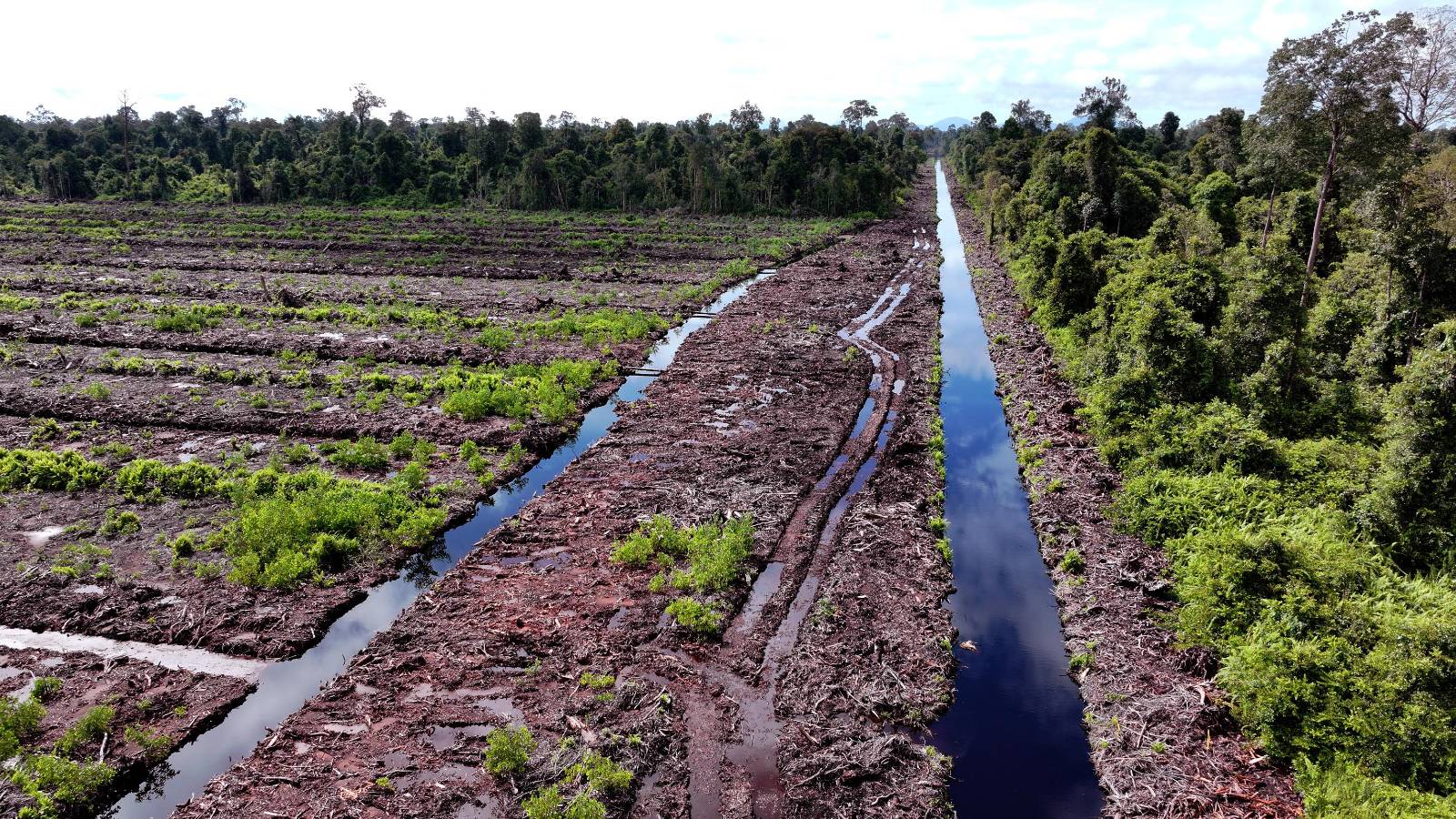
Recently cleared land in the concession of PT Mayawana Persada, where canals have been constructed to drain peatland, 2024
If APRIL has determined PT IFP and PT MP to be currently compliant with SFMP 2.0 and its Wood and Fibre Sourcing Policy, this indicates a creative interpretation that focuses only on those areas of the companies’ concessions which were cleared prior to 2020, and conveniently disregards the vast areas of natural forest that both companies have cleared since, as well as the ongoing social conflicts this clearance has triggered.
This echoes the approach of the timber labelling scheme PEFC, which has recently granted ‘sustainable’ certification to both PT MP and PT IFP. PEFC’s policy allows auditors to certify certain parts of a company’s concession, even if it has recently deforested large areas elsewhere. This approach has been criticised by NGOs as amounting to “greenwashing of some of the industry’s most environmentally and socially damaging actors.”
APRIL’s letter to Earthsight states: “APRIL will accept wood supply that is compliant with our Wood and Fibre Sourcing Policy from compartments converted or deforested prior to 31 December 2020. All supplies will be verified using EUDR-compliant, high integrity traceability down to the compartment level.”
This approach sends a dangerous message to concession holders in Indonesia: they can continue clearing forest, safe in the knowledge that the moment they halt clearance and adopt a no-deforestation policy, they may be welcomed as a ‘sustainable’ supplier, with no obligation to restore destroyed forest or resolve conflicts with local communities.
Self-defeating move risks access to European markets
The decision to buy from PT IFP and PT MP could mean APRIL will be effectively unable to sell its products to EU markets after 30 December 2026, when the EU Deforestation Regulation (EUDR) is enforced.
The EUDR will require any company importing wood, pulp or paper to the EU to trace the product back to the point of harvest, and establish there is ‘negligible risk’ that it came from land deforested after 2020. It will be almost impossible to reach this threshold for APRIL products if the company continues to buy from anywhere in the concessions of PT MP or PT IFP, the NGO open letter argues. This is due to the risk of mixing with non EUDR-compliant material from areas cleared since 2020 and the challenges of consistently segregating supply chains containing raw material from different sources.
The EU Commission has published a set of Frequently Asked Questions relating to implementation of the EUDR, in which it flags that where a commodity is sourced from anywhere within a property where post-2020 deforestation has occurred, the importer will have to “achieve negligible risk, taking into particular account the high risk of mixing within the single property.”
The NGO letter argues that, in practice, EU companies are likely to avoid purchasing from any exporter which buys wood from concessions where recent deforestation has been documented, to avoid potential exposure to non-compliant material and the consequent risk of penalties. This risk is particularly pertinent in the case of pulp and paper supply chains, where ensuring traceability and segregation of raw material from multiple disparate sources is very challenging.
In its letter to Earthsight, APRIL wrote that the corporate group “reaffirms its readiness for compliance with the EUDR.”
The EU is a major export market for APRIL Group companies. Challenges in determining EUDR compliance could therefore have a major impact on the company’s bottom line. Earthsight analysis of shipment records indicates that APRIL Group company PT Anugrah Kertas Utama exported more than 168,730 tonnes of paper and paperboard to EU countries in the period January 2025–April 2026, representing 32.2 per cent of the company’s total exports. Another APRIL Group company, PT Riau Andalan Paperboard International, exported more than 43,000 tonnes of paperboard to the EU in this period.
APRIL undermines hopes of regaining green label
The NGOs also argue that APRIL’s decision to buy from PT MP and PT IFP could put an end to its hopes of regaining certification under leading green label Forest Stewardship Council (FSC).
Ten years after cutting ties with APRIL over extensive deforestation in its supply chains, FSC launched a ‘remedy process’ with the company in 2023, setting out a path for it to regain certification by addressing past environmental and social harms. The process was suspended in September 2025 after allegations of violence against members of an Indigenous community in Sumatra involving RGE supplier PT Toba Pulp Lestari.
By buying from PT MP and PT IFP without requiring the two companies to restore deforested land or resolve social conflicts, APRIL is adopting the same harmful practices that led to FSC cutting ties in the first place. The NGO open letter argues: “This would appear to be grounds for the termination of the remedy process and an end to APRIL’s hopes to regain FSC certification.” Earthsight has made FSC aware of the recent developments.
In its response to Earthsight, APRIL stated: “We also continue to engage with FSC International on our remedy process which we remain keen to implement.”
Twenty-three NGOs from Indonesia, Europe, United States and Canada are calling on APRIL to:
- immediately reinstate SMFP 2.0 with the deforestation cut-off date of 2015
- remove PT Industrial Forest Plantation and PT Mayawana Persada from its list of approved suppliers
- commit to not purchasing any further material from PT Industrial Forest Plantation
- commit to not buying from any other company that has cleared natural forest since 2015